


Best Firmex Alternatives in 2026: Top 7 Data Rooms Compared

Quick answer:
- Ideals is the best overall Firmex alternative for 2026, built specifically for the complex, high-stakes M&A due diligence process rather than general file storage.
- For litigation support and life sciences work with deep compliance needs, ShareVault most closely matches what Firmex traditionally offered.
- Teams running large, multi-billion-dollar M&A should look at Datasite or Intralinks for enterprise-scale deal rooms.
- For IPOs, de-SPACs, and other regulatory filings, DFIN’s Venue platform is purpose-built for that specific workflow.
Why teams are looking for Firmex alternatives
Firmex has operated as a standalone brand inside Datasite since Datasite acquired it in July 2021 for an undisclosed sum. Datasite later acquired Ansarada in August 2024 for roughly AUD 236 million. That means three of the seven products compared here — Datasite, Firmex, and Ansarada — now share one corporate owner, even though they stay separately marketed and separately priced.
That consolidation is the main reason search demand for this term exists right now. Here’s what it actually means for a buyer: picking Firmex over Ansarada doesn’t diversify your vendor relationship the way it looks like it would on paper, since a renewal problem with one can turn into a renewal problem with the group.
Two other factors shape the search. First, Firmex’s own pricing isn’t published on a simple price card, so teams comparing total cost have to request a quote before they can compare anything. Second, G2 reviewers who praise Firmex’s ease of use and security still note that permissions get complicated once a room has several reviewer groups, and that uploads slow down once a room holds a large volume of files.
This guide covers seven providers side by side: Ideals, Firmex, Datasite, Intralinks, DFIN’s Venue platform, ShareVault, and Ansarada. The comparison below is followed by a closer look at each platform’s security, pricing, analytics, workflow, and usability.
Firmex alternatives compared
The table shows how each provider handles pricing, security assurance, and user-reported ratings.
| Provider | Best for | G2 rating | Security rating (UpGuard) | Security assurance | Pricing model | Granular access control |
|---|---|---|---|---|---|---|
| Ideals | Complex, high-stakes M&A due diligence | 4.7 (871) | 948/950 (A) | ISO 27001; SOC 2 assurance | Tiered plans (Core, Premier, Enterprise) | 8 levels |
| Firmex | Recurring diligence and compliance reviews | 4.6 (90+) | 869/950 (A) | ISO 27001; SOC 2 assurance | Per-project, or annual data volume | 6 levels |
| Datasite | Large-cap, enterprise M&A | 4.5 (440+) | 867/950 (A) | ISO 27001; SOC 2 Type II; ISO 42001 | Custom quote | 5 levels |
| Intralinks | Large, multi-party M&A with heavy redaction needs | 3.8 (32) | 860/950 (A) | ISO 27001; SOC 2 Type II | Customized transaction quote | 5 levels |
| DFIN (Venue) | IPOs, de-SPACs, and regulatory filings | 4.4 (29) | 841/950 (A) | ISO 27001; SOC 2 Type II | Per-page pricing with flexible subscription terms | Not publicly specified |
| ShareVault | Life sciences, legal, and IP licensing | 4.6 (92) | 761/950 (B) | ISO 27001; ISO 42001 | Quote-based, by data volume and project duration | 7 levels |
| Ansarada | Bidder and engagement analytics | 4.5 (238) | 830/950 (A) | ISO 27001; SOC 2 Type I | Custom quote | 5 levels |
UpGuard’s security rating measures each vendor’s external attack surface on a 950-point scale, independent of what the vendor itself claims. UpGuard’s rating methodology is useful alongside published certifications, not instead of them, since a strong attack-surface score doesn’t by itself confirm a certification is current.
Security track record
Six of the seven providers have no publicly disclosed breach on record. Datasite was named among the organizations affected by the 2023 MOVEit file-transfer attack.
That’s a genuinely different picture from some general-purpose file-sharing tools: a flaw in ShareFile’s customer-managed storage zone controller (CVE-2023-24489) made CISA’s Known Exploited Vulnerabilities catalog in August 2023, for comparison. Ideals is the only vendor here that makes an explicit, sourced claim about its own history, reporting zero breaches over nearly 20 years in business.
Ask each vendor directly for its current security questionnaire or SOC 2 report before relying on this as your only check.
1. Ideals
Best for: complex, high-stakes M&A due diligence, not general document storage.
G2 rating: 4.7/5 (860+ reviews) | Security rating (UpGuard): 948/950 (A)

Ideals’ due diligence checklist, automated Q&A workflows, and AI-powered redaction follow how a deal team actually works through a room. Teams can stage documents before launch, then track buyer engagement once diligence starts. Ideals reports zero breaches in nearly 20 years, with eight document-permission levels and Fence View screenshot protection.
Pricing runs on three transparent tiers, Core, Premier, and Enterprise, so cost scales with deal complexity instead of a one-size custom quote. Support includes 24/7 live chat, with dedicated experts on higher-tier plans.
Trade-off: Ideals’ broader feature set (multilingual interface, DWG file support, built-in e-signature) can be more than a short, single-deal project needs. Teams running one small transaction a year sometimes find a lighter tool sufficient.
For a broader overview of top data room providers, explore our detailed virtual data room comparison guide to see how Ideals performs against other top platforms.
2. Firmex
Best for: recurring diligence and compliance reviews, especially litigation support and life sciences work.
G2 rating: 4.6 (90+ reviews) | Security rating (UpGuard): 869/950 (A)
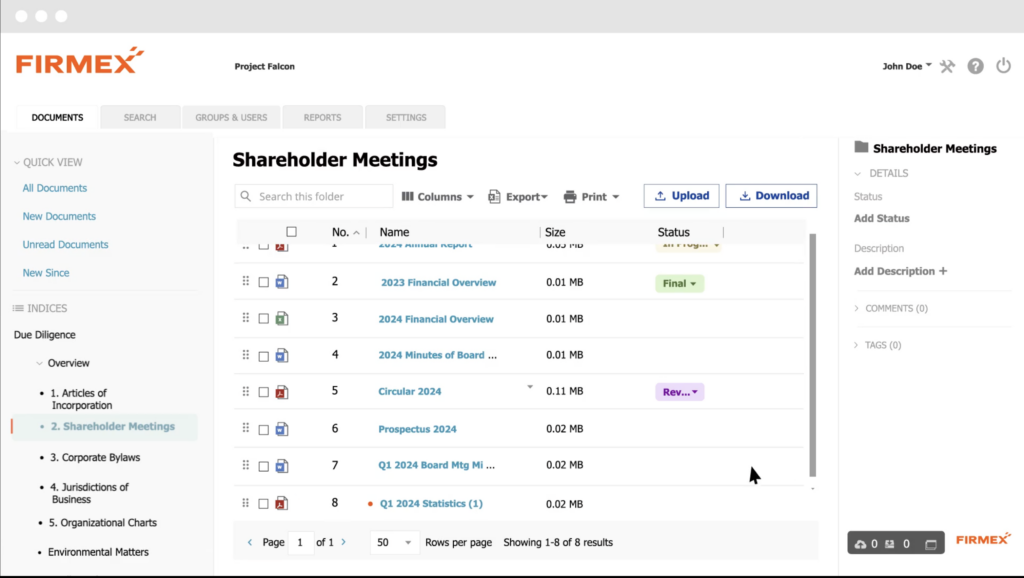
Firmex was founded in Toronto in 2006. It built its reputation on structured document management for law firms, accountants, and financial advisors, where different reviewer groups need different levels of access to the same document set. G2 reviewers consistently highlight its straightforward design, with several noting that even non-technical staff can organize a large set of confidential files without help.
Datasite acquired Firmex in July 2021 for an undisclosed sum. Firmex doesn’t publish current pricing on a public price card, so confirm figures directly rather than relying on older estimates. Historically reported figures put costs around $150–500 per month, or $5,000–$10,000 for a 3-month project. Those numbers quickly go stale, and actual costs vary with storage volume and project length.
Trade-off: some G2 reviewers report complicated permissions, slower uploads with large data sets, and weaker search and filtering than newer platforms.
3. Datasite
Best for: large-cap, enterprise M&A with multiple advisors and jurisdictions.
G2 rating: 4.5/5 (390+ reviews) | Security rating (UpGuard): 867/950 (A)
Datasite’s workflow tools, AI features, document preparation, Q&A, redaction, and analytics are built for major transactions. Investment banks and corporate advisors use it to coordinate extensive document review across large deal teams. In head-to-head G2 comparisons, reviewers specifically credit Datasite for turning unstructured data into a presentation-ready format, useful for fundraising and debt-financing processes where materials go straight to investors.
Pricing is custom enterprise pricing only, so prospective clients need to contact sales for a deal-specific quote.
Trade-off: the relevant question isn’t headline cost, but which workflow, support, security, and analytics capabilities are actually included in the proposed package. G2 reviews are a useful cross-check before that conversation.
4. Intralinks
Best for: large, multi-party M&A with heavy redaction needs.
G2 rating: 3.8/5 (32 reviews) | Security rating (UpGuard): 860/950 (A)
Intralinks is a long-established enterprise VDR used for large M&A processes with multiple bidders and extensive document sets. Investment bankers rely on it for structured permissions, large-scale redaction, and controlled sharing across several participant groups. Familiarity with the platform can also reduce onboarding friction when counsel, banks, and buyers have used it before.
Full-text search, document tracking, and activity monitoring are commonly cited strengths, and support availability draws real praise even from reviewers otherwise unimpressed with the interface.
Trade-off: usability and pricing transparency. Intralinks doesn’t publish a standard rate card, and reported pricing varies by contract, which matters most in carve-outs and other deals where the document universe may grow after the room opens. Some G2 reviewers also describe the platform as overcomplicated relative to newer competitors.
See our full Intralinks alternatives comparison for a deeper look at where Ideals and Intralinks differ on permissions, pricing, and support.
5. DFIN (Venue)
Best for: IPOs, de-SPACs, and other regulatory filings.
G2 rating: 4.4/5 (29 reviews) | Security rating (UpGuard): 841/950 (A)
DFIN Venue focuses heavily on securities offerings and regulatory filings. Two-factor authentication, index management, and controlled permissions reflect DFIN’s broader experience in regulatory disclosure and financial communications.
Venue fits teams whose priority is structured disclosure and document control, not a buyer-engagement auction process. Organizing materials around legal, accounting, and filing workstreams tends to matter more here than bidder-analytics tools. Venue’s public G2 review footprint is thinner than most providers on this list, so weight any single review accordingly.
Trade-off: contract-specific pricing, including page-based charges, can make total costs hard to forecast for data-heavy projects. Confirm whether Venue’s specialized workflow fits if you plan to reuse it for conventional M&A. See our full DFIN Venue alternatives comparison for more detail.
6. ShareVault
Best for: life sciences, legal work, and IP licensing.
G2 rating: 4.6/5 (92 reviews) | Security rating (UpGuard): 761/950 (B)
Page-level permissions, real-time document analytics, AI-powered redaction, and heat maps let administrators see exactly where reviewer attention concentrates across a room. In licensing, fundraising, or life-sciences deals, that signal helps a team anticipate likely follow-up questions. In side-by-side G2 comparisons against larger enterprise VDRs, ShareVault reviewers specifically call out its security controls and audit trails as the reason they feel comfortable sharing sensitive documents, alongside a genuinely quick, intuitive setup.
Trade-off: pricing is quote-based, driven by data volume and project duration, so buyers need a deal-specific proposal before comparing costs. ShareVault’s UpGuard rating is also lower than the other platforms here, worth a direct question to the vendor if attack-surface posture matters to your evaluation.
7. Ansarada
Best for: bidder and engagement analytics on advisory-led deals.
G2 rating: 4.5/5 (235+ reviews) | Security rating (UpGuard): 830/950 (A)
Ansarada’s AiQ Bidder Engagement Score analyzes bidder behavior to help advisors gauge interest during a competitive process. For advisors running several transactions at once, it adds insight beyond basic login statistics by showing which bidders interact most actively with key materials as a deal develops. G2 reviewers consistently praise its intuitive interface and responsive customer support, and several specifically credit its usage-monitoring statistics as a feature competitors don’t match.
Datasite acquired Ansarada in August 2024.
Trade-off: that ownership change has reshaped the competitive landscape. Organizations focused on vendor independence should weigh the relationship between Datasite, Firmex, and Ansarada before treating Ansarada as a fully separate option.
How to choose a Firmex alternative
Match the provider to your deal type rather than defaulting to one name for every use case:
- Litigation support and life sciences. Firmex’s structured folder system and ShareVault’s certification depth both suit recurring, compliance-heavy review work where the same document types come up deal after deal.
- Mid-market M&A. Ideals combines due diligence-specific workflows with a tiered, quote-based pricing structure, letting teams request a quote based on actual project requirements rather than a standard per-page rate.
- Wary of the Datasite upsell path. Intralinks sits outside the Datasite/Firmex/Ansarada ownership group entirely, which matters if vendor independence is part of your evaluation criteria, not just a feature checklist.
- Cross-border M&A. Ideals’ multilingual interface and broad security and compliance support, including ISO 27001 certification and controls designed for GDPR and HIPAA requirements, support deals spanning multiple jurisdictions at once.
- Large, multi-billion-dollar M&A. Datasite and Intralinks are both built for the document volume and multi-advisor coordination that scale of deal requires, with support teams accustomed to that pace.
- IPOs, de-SPACs, and regulatory filings. DFIN’s Venue platform is purpose-built for that specific filing and compliance workflow.
When comparing providers, look beyond headline feature lists. Ask how each platform handles user permissions, analytics, support, project limits, storage, and pricing, and confirm which functionality is included by default versus which requires a higher-tier package.
Compare analytics and reporting depth
Analytics can look similar on a feature checklist but differ once a transaction is live. Some VDRs focus mainly on logins, views, and download histories, while others offer bidder scoring, page-level behavior, or heatmaps. For sell-side advisors, these differences matter because activity data can help prioritize buyer follow-up, while legal and compliance teams often prioritize a clear, auditable access history instead.
Ask for a demonstration based on a realistic transaction structure before deciding which approach actually fits your team.
Compare administration and access controls
Administration becomes more demanding as a deal adds bidders, lenders, advisors, or specialist reviewers. The room should make it simple to create user groups, modify permissions, and restrict sensitive material without rebuilding the project structure, particularly for staged disclosure where early-stage bidders see high-level documents and shortlisted parties later gain access to contracts or financials.
Time spent maintaining groups and troubleshooting access is part of a platform’s real cost, even when it never appears on the invoice.
Compare pricing on the same assumptions
VDR quotes are hard to compare when providers use different commercial models: one may depend on data volume, another on project duration, another on a broader enterprise agreement. Before comparing totals, give every provider the same assumptions, expected storage, duration, administrator count, and required support, and ask what happens if the transaction runs longer than planned.
A room that looks inexpensive for three months can become less attractive once extension charges apply.
FAQ
The main Firmex alternatives are Ideals, Datasite, Intralinks, DFIN Venue, ShareVault, and Ansarada. Each fits different deal types: Ideals for mid-market deals, Datasite and Intralinks for complex deals and investment banking, ShareVault for life sciences and legal work, and DFIN for capital-markets transactions. Datasite acquired Firmex in 2021 and Ansarada in 2024.
Ideals is a strong option for small-business M&A and lower middle-market deals. Its Core plan supports one project, five admins, and unlimited users, while higher tiers add broader workflow and project capabilities. Teams comparing Firmex pricing should still request like-for-like quotes, since Ideals uses tiered, quote-based pricing rather than a single published rate.
Yes. Ideals combines a straightforward interface with secure document sharing, structured Q&A, and controlled user access, making it suitable for teams that include non-technical stakeholders. G2 reviewers consistently cite fast onboarding as a reason teams switch from other platforms.