


The new physics of M&A: What factors really impact deal speed?

As the global M&A market heads into the final stretch of 2025, one question preoccupies dealmakers more than any other: why do some transactions glide to completion, while others grind through months of diligence and negotiation?
M&A deal timelines have been steadily increasing since 2019, apparently driven by economic challenges, regulatory complexity and stricter financing conditions. However, our analysis of deals managed through the Ideals Virtual Data Room (VDR) suggests this trend may have reached a plateau last year. We found a modest 4% reduction in the average time to close a deal in 2024, from 266 days in 2023 to 255 days.
Although incremental, this is the first decline in several years, suggesting that deal timelines may have finally peaked.
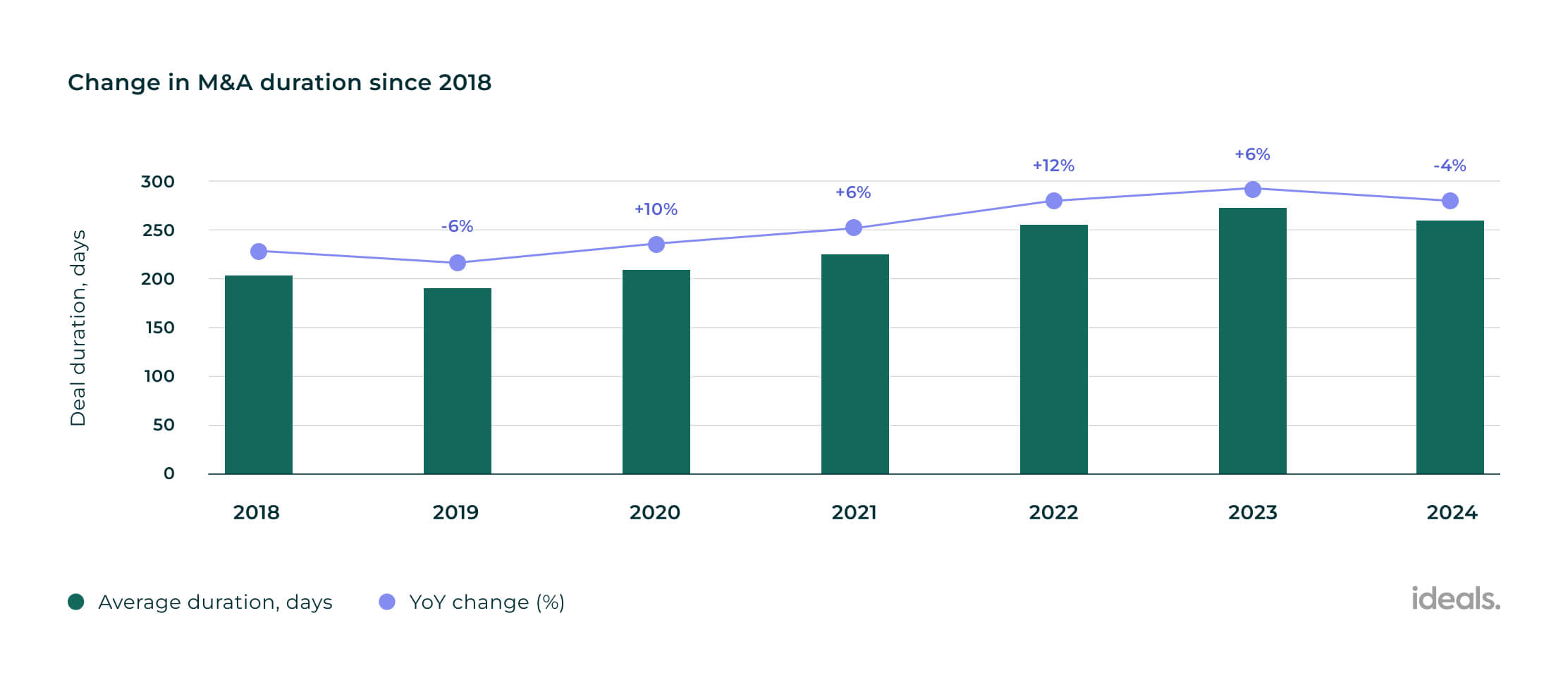
Caption: Deal timelines were steadily expanding until last year (Source: M&A Deal Trends Report 2025, Ideals)
Beneath the volatility lies a clear pattern. Deal speed is shaped less by macro conditions than by the structural realities of the deal itself: its sector, complexity, regulatory burden and, increasingly, the technology used to execute it.
The gap between sectors
The difference in deal timelines is starkest when viewed across sectors: some close quickly, while others are slowed by regulation and operational complexity. Perhaps unsurprisingly, the technology sector is leading the way. Transactions in this space closed in an average of 244 days, approximately 13% quicker than the overall industry average of 280 days, and 13% faster than the sector’s own average in 2023.
“There’s heightened interest in the infrastructure that enables the AI ecosystem,” says Chin-Harn Leong, a Partner in KPMG’s TMT Transaction Services. “Data centers, fiber networks, and cybersecurity platforms are all seeing increased demand. They’ve become central to the AI-driven investment landscape.”
Other sectors tend to struggle with a more sluggish pace of dealmaking. In heavily regulated industries such as Environmental & Utilities and Energy & Mining, transactions regularly stretch beyond 340 days. Whether the issue is permitting, environmental assessments or local compliance obligations, regulatory friction outweighs any benefit from cheaper financing or improving sentiment.
This trend looks set to continue into 2026. AI is reshaping infrastructure investing, with data centres, fibre networks and grid assets attracting the lion’s share of capital. At the same time, critical clean-energy and low-carbon infrastructure projects continue to face significant regulatory and financing challenges, leaving a funding gap that slows the transition despite growing investor interest.
Complexity still trumps confidence
If the sector determines the starting point, size and complexity sets the pace. Our analysis shows that the number of users in the VDR – a proxy for deal size – correlates with timeline length.
Smaller deals, with 0-10 VDR users, remained the fastest, averaging 222 days in 2023 and 225 days in 2024. These transactions typically involve fewer stakeholders, simpler due diligence and fewer obstacles to agreement.
In contrast, the largest deals, with 50-100 users, were the longest to close, with average timelines rising from 311 days in 2023 to 351 days in 2024. This reflects the added complexity of larger transactions, as well as perhaps a tendency for higher-value dealmakers to wait for more favorable market conditions.
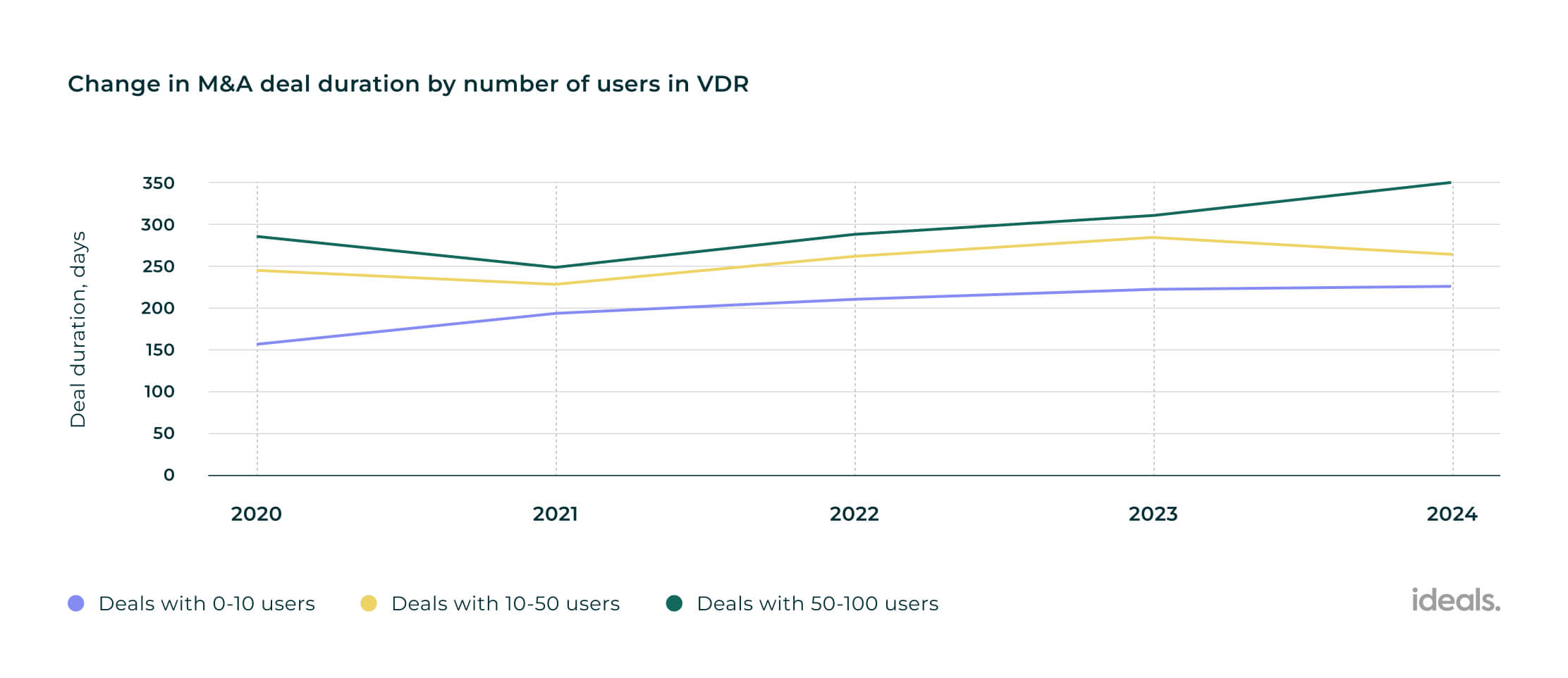
Caption: Larger deals tend to take longer to close than smaller ones, and the gap is widening (Source: M&A Deal Trends Report 2025, Ideals)
The intensity of due diligence continues to grow alongside timelines. In 2024, M&A professionals spent an average of 180 hours per deal in our VDR – a 41% increase compared with 2023. This shows that although timelines may be shortening, the intensity of due diligence continues to grow. This rise in workload reflects a longer-term trend: in H1 2024, dealmakers spent 191 hours per deal, up 35% from H1 2023 and considerably higher than in 2020. The workload peaked in H1 2021 at 194 hours per deal, before stabilizing in subsequent years.
This complexity has remained a key driver of deal workload this year. Foreign-direct investment (FDI) regimes are broadening, with 38% of deals now including regulatory clearance conditions – a sharp increase from just a few years ago. This heightened scrutiny means that even well-planned transactions can face extended timelines.
Meanwhile, ESG considerations continue to slow dealmaking, a trend we first identified in 2024. Companies are adapting to the EU’s Corporate Sustainability Due Diligence Directive, which requires deal teams to assess human-rights and environmental risks across value chains.
The impact of this is becoming clearer, with one in five dealmakers reporting that ESG considerations led to disputes over the past year.
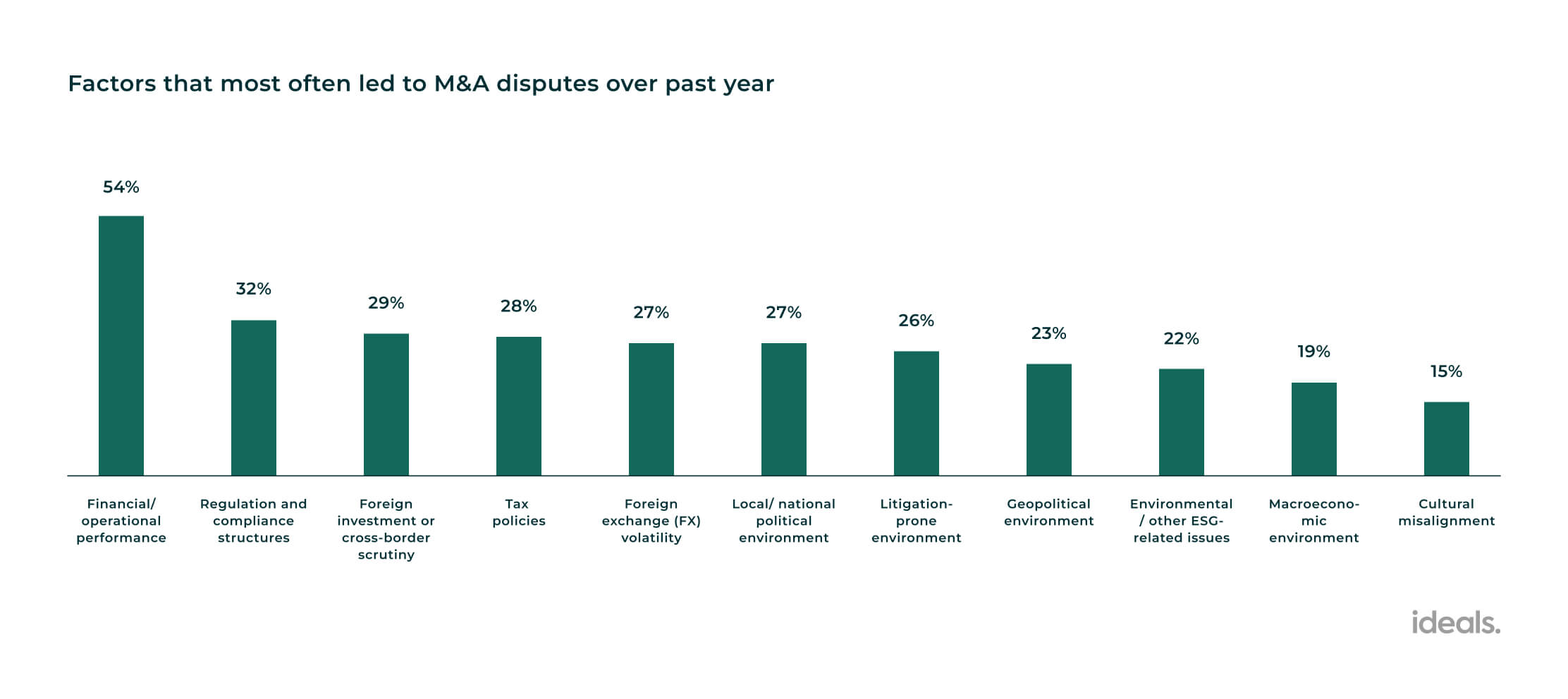
Caption: ESG considerations often led to M&A disputes over the past year (Source: BRG, M&A Disputes Report 2025)
In response to these pressures, some acquirers are adopting a more disciplined approach. McKinsey notes that successful dealmakers are focusing on transactions that strengthen core businesses through consolidation or geographic expansion, while avoiding the riskier deals that were common during the “free money” era of low interest rates.
They’re also managing risk through rigorous due diligence and deal structures designed to distribute exposure across buyers and sellers.
We’ve seen this play out firsthand over the past year. “Our customers are going beyond the numbers,” explains Deven Monga, VP of Sales, North America at Ideals. “They’re bringing in legal, operational and ESG experts to understand the full picture and ensure any potential issues are fixed well before the deal closes.”
AI puts deals in the fast lane
Another way dealmakers are accelerating progress in a demanding M&A environment is by integrating AI into their workflows. The most innovative VDRs use AI to scan hundreds of documents, summarizing content and answering specific queries with referenced sources. Dealmakers also benefit from AI-assisted redaction and real-time translation, allowing cross-border teams to review documents instantly.
According to Deloitte’s 2025 survey, 86% of corporate and private-equity executives now use generative AI for dealmaking, and 83% have committed at least US$1 million to it. 40% of those adopters apply it at the earliest stages, such as strategy and target screening, and 35% are using it for due diligence. Adoption will accelerate rapidly: 84% of M&A professionals plan to scale GenAI use across their deal processes by 2027.
These tools are reshaping the cadence of deals by compressing routine tasks, flagging risks earlier and helping cross-functional teams collaborate with more precision. In sectors where speed is a strategic advantage, they’re becoming a competitive necessity.
“Technology is being seen by dealmakers as an essential tool to increase the efficiency and speed of due diligence, as well as regulatory and cybersecurity compliance,” reflects Sabine Schilg, VP of Corporate Development at Ideals.
The 2026 M&A boom: Who will be ready?
The patterns we’ve seen up to 2025 offer an important lesson for the year ahead. They show that how fast a deal closes depends not only on pre-determined conditions such as market timing, sector and structural complexity, but also on the effective use of technology.
This matters, because global M&A could hit $3.9 trillion in 2026, potentially surpassing the 2021 record, according to Goldman Sachs, with easing interest rates and AI-driven dealmaking driving progress.
In the US alone, EY-Parthenon predicts deal volumes for transactions above $100m to grow 9% in 2025 and 3% in 2026, with corporate M&A up 10% and private equity up 8% in 2025.
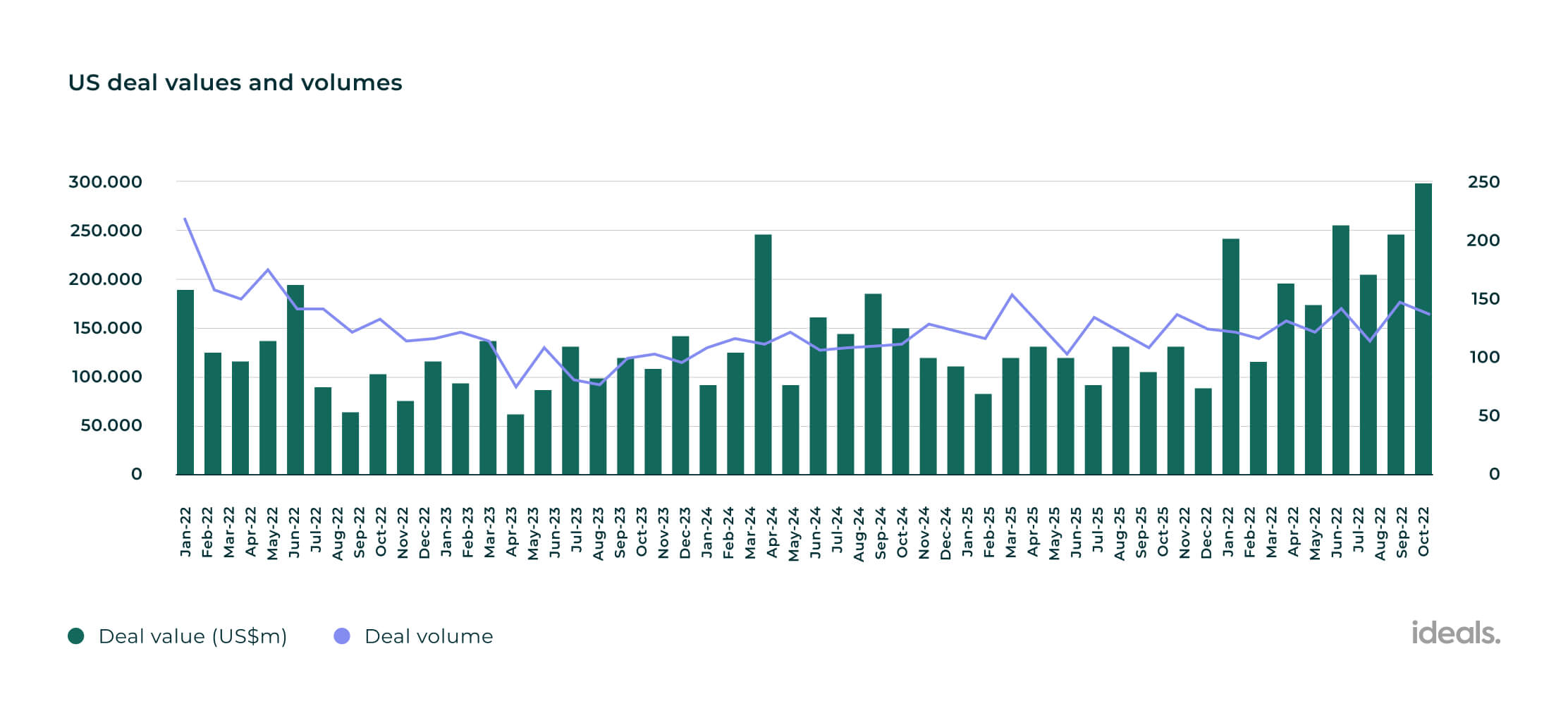
Caption: US deal values have been rising as 2025 comes to a close (Source: US M&A activity insights: October 2025)
Firms that understand how to anticipate sector and structural challenges, plan transactions carefully and deploy technologies such as AI-powered VDRs will capture value fastest in this dynamic environment – and do so with fewer surprises once the ink dries.