


M&A momentum builds as dealmakers move from caution to action: New research

Tariffs, geopolitical shocks, and valuation uncertainty weighed heavily on M&A activity in 2025, prompting many buyers and sellers to delay transactions.
In the first half of 2026, that caution began to ease. New analysis of transactions completed through the Ideals Virtual Data Room (VDR) shows a market regaining momentum, with deals closing faster, activity increasing, and teams moving with greater urgency despite continued uncertainty.
Our M&A Mid-Year Review 2026 explores these trends and what they reveal about the state of the deal market.
Deals are moving faster, but not becoming simpler
M&A transactions completed during H1 2026 took an average of 253 days to close, down 4% year-over-year (YoY) and the shortest average timeline since 2022.
However, faster execution does not mean simpler deals. Instead, deal teams appear to be compressing timelines while maintaining a higher level of scrutiny.
David Acharya, Managing Partner at Acharya Capital Partners, says buyer priorities have shifted: “Financing is no longer the biggest obstacle to getting deals done. Buyers are paying more attention to diligence, contract quality, and earnings normalization.”
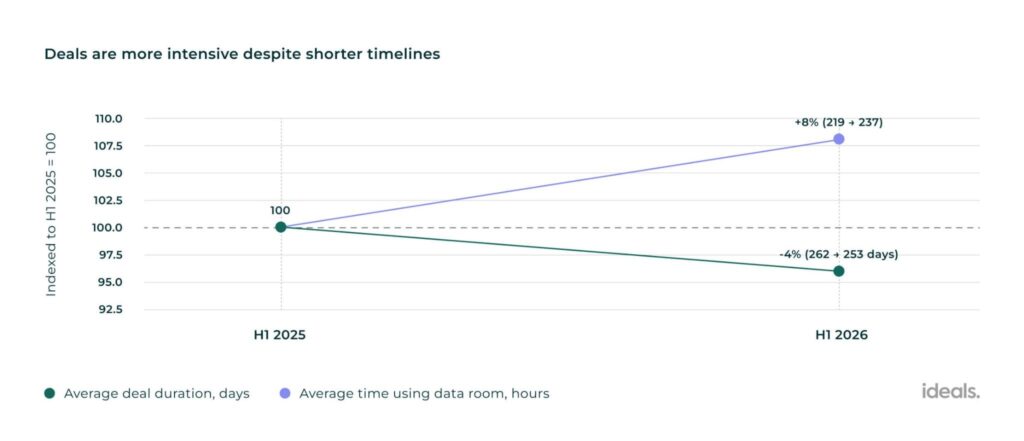
That shift is reflected in how teams are approaching transactions. Hours spent in the VDR per deal increased from 219 to 237, up around 8% YoY. This suggests that shorter timelines are being achieved through more intensive preparation rather than reduced diligence.
What is driving renewed deal activity?
Several factors are contributing to the momentum in M&A, including improved access to financing and growing pressure on investors to deploy capital.
Private equity sponsors, many of which have held assets for longer than originally planned, are increasingly looking toward exits to return capital and create capacity for new investments.
As Marc Potel, Head of Industrial M&A at Investec, puts it: “Private equity exits need to be revisited if we are going to unclog the system, but that will happen over time.”
Broader market conditions are also becoming more supportive. KPMG reports that 86% of M&A leaders now describe access to capital as abundant or adequate, while McKinsey notes a growing fear of missing out among dealmakers, encouraging buyers and sellers to pursue opportunities sooner.
That renewed confidence is reflected in Ideals VDR data. The number of new M&A data rooms opened on the platform increased 23% YoY in H1 2026, with activity remaining resilient across both quarters despite renewed geopolitical instability, most notably the outbreak of war in the Middle East.
Momentum has returned unevenly
The improvement in dealmaking activity has varied across regions and industries.
Western Europe overtook North America in deal speed during H1 2026, reversing the pattern seen in our previous report. Average deal timelines in Western Europe fell to 248 days, compared with 250 days in North America.
Maurice Harbison, Partner at Carlsquare, has observed differing levels of activity across European markets.
“We’re seeing positive improvements in overall market dynamics, with signs of stabilization. Germany has improved, Scandinavia is particularly active, while France remains a more challenging market given the current economic environment. In the UK, we’re hopeful that recent political changes will support further momentum.”
Sector performance also paints a nuanced picture. Financial Services recorded the fastest deal timeline in our data, while Healthcare & Biotechnology experienced far longer processes as buyers applied greater scrutiny to growth expectations.
In technology, shifting expectations around AI are reshaping valuations and extending transaction timelines.
AI is changing both deal strategy and execution
AI is shaping M&A in two ways: as a driver of transactions and as a tool changing how deal teams execute them.
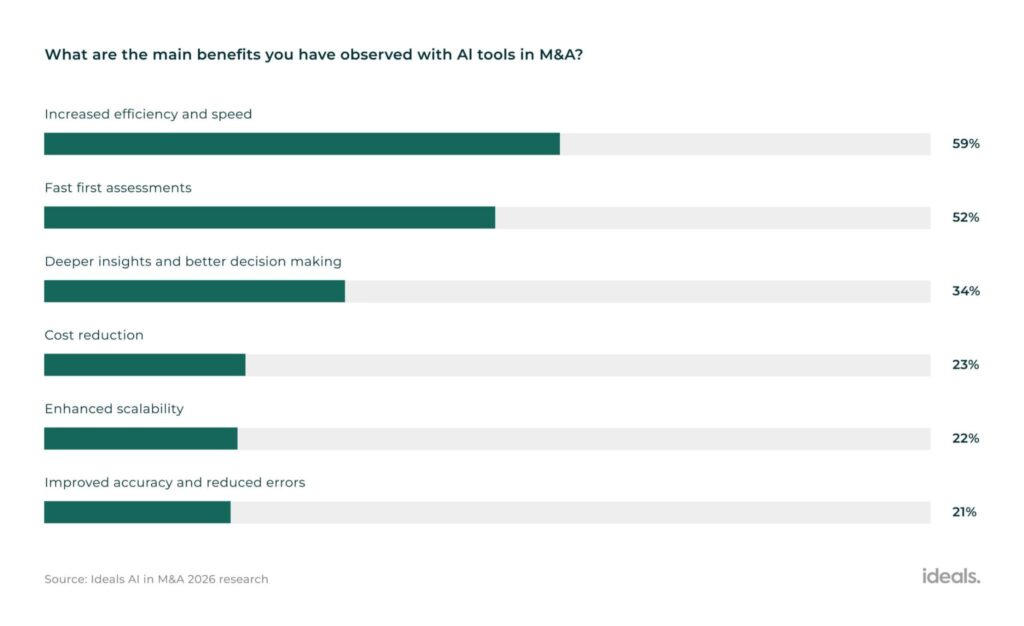
Our AI in M&A 2026 research found that 59% of dealmakers cite faster execution and improved efficiency as the primary benefits of using AI. As adoption increases, the technology is helping teams process information more effectively and focus attention on the issues that require judgment.
Nitin Premchandani, Senior Director in PwC’s Infrastructure M&A Advisory team, explains this impact in practice.
“At any given time, I may be working across several live processes, each requiring a detailed understanding. AI helps me process and prioritize information more efficiently, so I can focus on the issues that matter most to clients and communicate with greater clarity.”
The next phase of dealmaking
The first half of 2026 suggests M&A has entered a more active phase. Dealmakers are no longer waiting for uncertainty to subside; they are adapting their processes to succeed despite it.
Their next challenge will be maintaining this momentum while continuing to execute deals with the speed and discipline required in today’s unpredictable market.