


How lawyers create value in cross-border M&A: A conversation with ERM
Israel’s M&A market has proven resilient in recent years, with activity thriving despite geopolitical uncertainty. As transaction volumes grow and deals become more complex, the lawyers structuring and executing them play a critical role in determining whether they close.
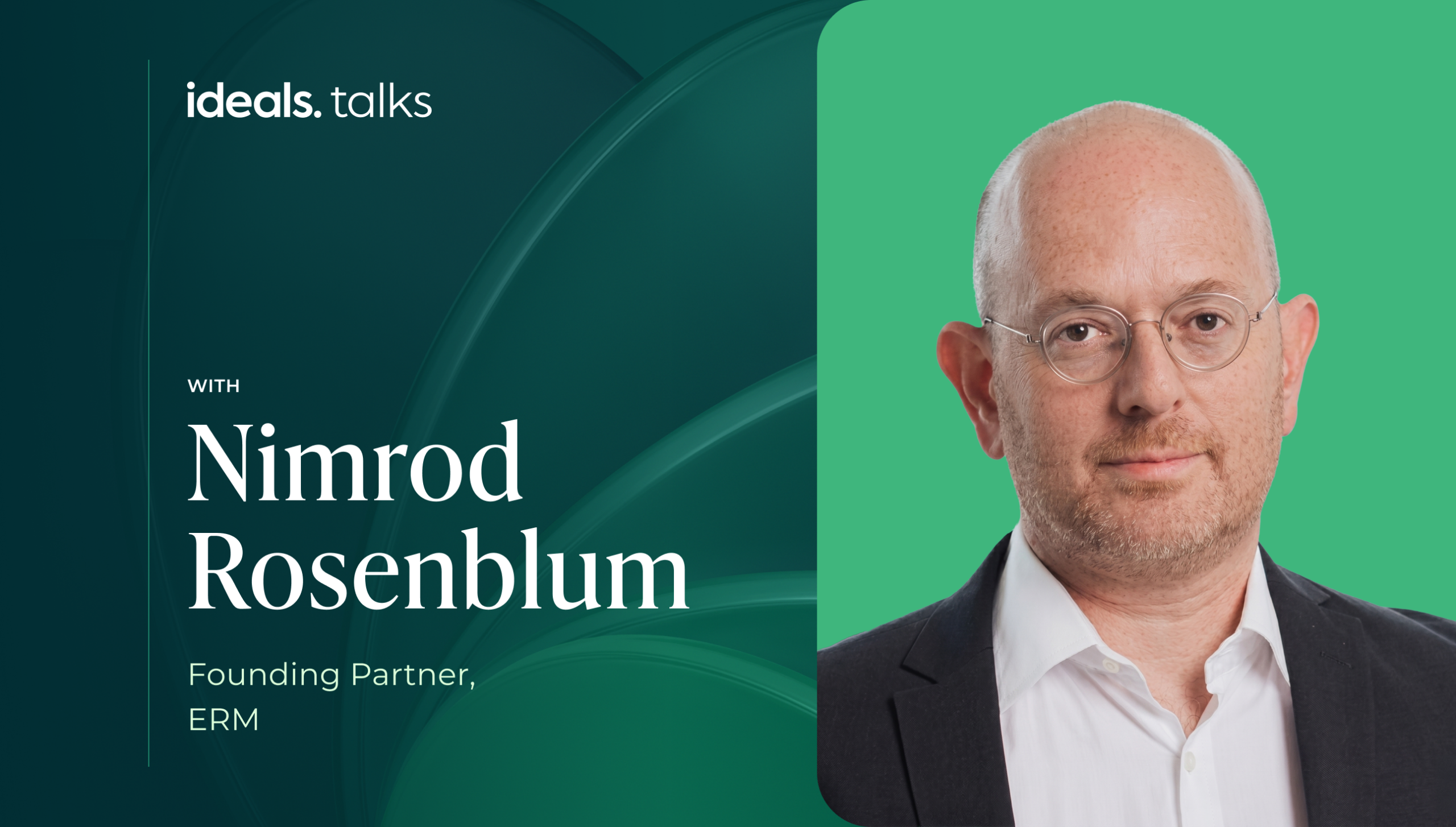
To understand what that looks like in practice, I spoke with Nimrod Rosenblum, founding partner at Epstein Rosenblum Maoz (ERM), a Tel Aviv-based firm specializing in cross-border M&A and private equity.
He shared his views on managing complex international transactions, what causes deals to succeed or fail, and how AI is changing the way lawyers work.
Q. How would you describe your firm’s approach to M&A work?
The heart and engine of ERM is M&A work, with a focus on cross-border transactions. Israel is relatively small with a population of around 10 million, so a lot of our business is international. In the corporate and M&A department, about 70% of our work is buy-side M&A, and we also have a strong emphasis on private equity.
Our approach is to work in small teams. We believe it’s more efficient, as each person gets a holistic understanding of the transaction. We try to educate our people to be good lawyers technically, but also to be pragmatic. That means focusing on the 20% of work that matters (and creates 80% of the value) rather than the 80% that can often just be noise.
We operate on a lockstep partnership model, which means we only have one P&L across the entire firm. This allows us to bring in partners based on their expertise, as they’re incentivized to work on every transaction where they are needed.
I was at a managing partners’ conference in New York two years ago, and the then-CEO of Paul, Weiss put it well: “eat what you kill” is good for partners, but lockstep is good for clients. At the end of the day, that’s the key thing.
Q. What’s the most memorable deal you’ve worked on, and why?
I remember representing Generali in 2012 on the sale of Migdal, Israel’s largest insurance company, in a transaction valued at around $1 billion. We were a small team of around 15 people, and it was a big challenge. The global law firm that referred it to us took a chance on us, and their reputation was on the line as well.
It was a complex cross-border transaction involving complex regulatory issues, antitrust, and financing. There was also a major crisis between signing and closing due to a change in regulation, and we helped solve this so that the transaction could complete.
I remember the day it closed, as it was the main headline in the Israeli financial press, and our name was mentioned. It was a stamp of recognition that we could do that kind of work. We are now much bigger and established, but I still look back at that transaction with a smile.
I’ve always been upfront that ERM is a smaller firm focused purely on transactional work, rather than a one-stop shop. That can make us a harder sell for some clients, because it’s easier to come with the business card of a large law firm. However, we work with sophisticated clients like Blackstone, SoftBank, Triton, Fresenius, Generali and others, and they understand that it’s about the quality of the team, not just the size.
Q. How do you coordinate advisers and stakeholders in that type of transaction?
It’s one of the most complex responsibilities of an M&A lawyer. What we try to do is create a very clear timeline and checklist early in the process and circulate it so people are on the same page. Weekly calls and ongoing communication are essential, whether that’s via email, video calls, or in-person meetings.
We also believe it’s critical to keep teams as lean as possible. If you have 15 lawyers on each side plus bankers and accountants, it becomes too difficult to manage. We try to avoid that where possible.
Finally, it’s essential to give precise instructions to local counsel. If I ask a lawyer to review a large volume of documents in a data room, their results may be unfocused, and the client will incur unnecessary costs. It’s much better to identify the materials they need to review and ask them to answer specific questions. That helps streamline the process.
Q. What are the most important lessons from working across jurisdictions that shape how you approach cross-border M&A?
The first lesson is to be humble. Don’t assume that the way you understand something is the way the other party understands it. More likely than not, that’s not the case. The second is to listen before you talk. This can be unfamiliar for lawyers as we love to talk, but you learn more from listening.
It’s also important to understand that another jurisdiction’s laws might not work the way you expect. Under Israeli law, there is an explicit duty to act in good faith, but in the UK that requirement doesn’t exist. That doesn’t mean UK buyers and sellers don’t act in good faith, but it can affect how deals are structured (e.g. break fees) and managed.
I always tell my team that we don’t have to be the loudest in the room. If a firm wants lawyers who will be aggressive for the sake of it, we’re probably not the right choice. But if they’re looking for lawyers who can build strong relationships, convey ideas clearly, be aggressive when it’s productive, and reach a settlement that works for both sides, that’s where we make a difference.
Q. Where do cross-border deals most often break down?
There are objective reasons, such as valuation gaps, material adverse changes, and regulatory shifts. After October 7th, some buyers who were about to purchase Israeli assets adopted a “wait and see” position, and certain deals were delayed. Fortunately, many of the deals ERM was involved in resumed and closed, because people understood that the economy and the target companies were strong. I don’t know of a single Israeli company which has missed a deadline due to the war.
From my experience, the main subjective reasons deals fail are psychological. If a deal drags on, people become worn down and that loss of momentum can affect its likelihood of closing.
On the other hand, if a deal is carried out at a good pace and in a productive atmosphere, there is goodwill to resolve problems when they arise.
Q. At which stage of the deal process do lawyers add the most value?
One is the term sheet. Some clients may not have done many M&A deals before, so we play an important role helping them plan ahead and focus on what matters at this preliminary stage.
We draw on experience from past transactions to predict issues and mitigate them. We also think carefully about what not to spend time on, because getting bogged down at the term sheet stage can jeopardize the whole transaction.
The second is the 2 a.m. scenario. When parties are exhausted and working hard to resolve challenges, clients need advisors who can calmly say “that’s fine, we’ll solve it.” That’s a really important role our team plays.
Q. How is AI changing the pace and execution of transactions?
The pace of tasks within transactions has sped up, whether that’s the turnaround of documents, how many versions are exchanged, and how quickly you’re expected to complete diligence. I can see a clear difference from 20, 10, and even five years ago.
There hasn’t been a diligence exercise in the last year where we didn’t use AI. If you have 75 employment contracts, AI can summarize them and it works really well.
That said, if a deal used to take 1,000 hours, it may now take 920. Time saved on certain tasks is quickly absorbed by others, so overall I think AI has moved the needle by around 10%. It will be interesting to see how much further that shifts in the years ahead.