


Making capital count: An investment banking career in emerging markets
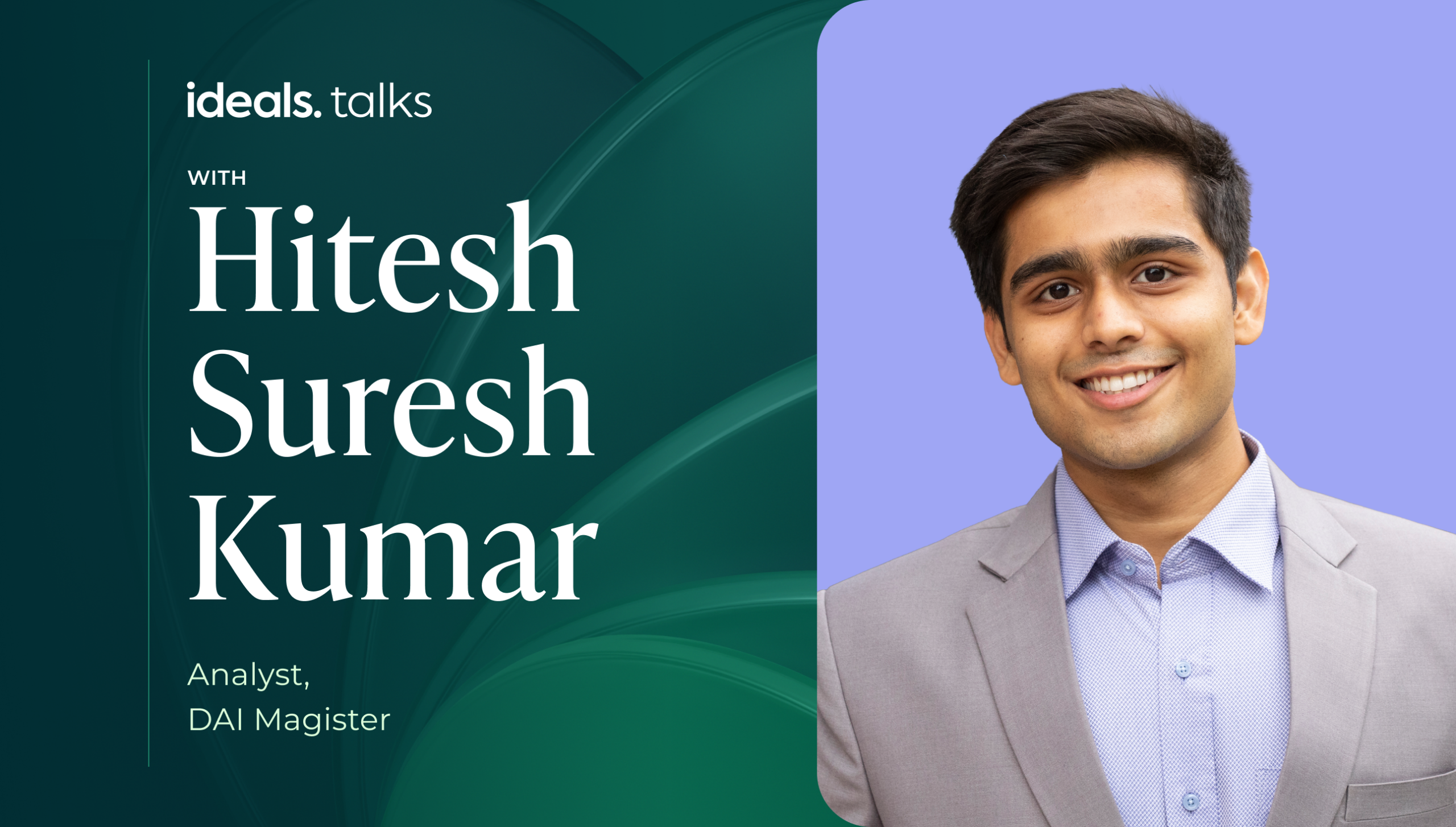
Growing up in India, Hitesh Suresh Kumar saw firsthand how difficult it is for promising businesses to access capital. That experience shaped both where he wanted to work and the kind of banker he wanted to become.
Now an analyst at DAI Magister in London, advising technology and growth companies across emerging markets, Hitesh shared his path from financial due diligence (FDD) to investment banking, the realities of life as a junior banker, and what it takes for emerging market businesses to attract institutional capital.
Q. You started your career in financial due diligence at KPMG. What made you choose that path?
I knew I was interested in finance but hadn’t narrowed down where I wanted to specialize. What I did know was that I wanted to build a strong grounding in fundamentals first, and FDD offered exactly that. It forces you to look critically under the hood of companies, rather than taking them at face value.
At its core, FDD is about asking the questions a buyer or investor would ask. What is the quality of a company’s earnings? Is growth coming from genuine demand? Where is the cash actually tied up? Spending the early part of my career on those questions, across different sectors, taught me how to look at a business the way an investor would, rather than how a founder pitches it.
I learned how to identify aggressive revenue recognition, or earnings that look impressive but don’t actually convert to cash. That knowledge informs how I view companies and shapes the decisions I make today.
Q. What motivated your move from professional services into investment banking?
I wanted to own the outcome, rather than just comment on it. In FDD, you’re typically brought in once the transaction is underway. You write your report, and the deal happens or doesn’t happen without you.
In banking you have real ownership. You run financial models, prepare investor materials, engage buyers, and run a tight process. Your work has a direct impact on whether the transaction completes, at what price, and on what terms.
I also wanted to work more closely with senior colleagues. At a boutique firm like DAI Magister, you sit alongside senior partners who are navigating investor dynamics, managing founder expectations, and making judgment calls on deal terms. That exposure is difficult to replicate anywhere else.
Q. How did your expectations of investment banking compare with reality?
A Mike Tyson quote captures it well: “Everybody has a plan until they get punched in the face.” That sums up my first six months in investment banking. I joined as an analyst and was thrown into the deep end, working on a complex tower lease model and a data center fundraise.
The hours were brutal, but that wasn’t the hardest part. The hardest part was realizing how much I didn’t yet know, and how much I needed to learn, while still being expected to produce precise work on very little sleep.
Looking back, those six months were the most formative of my career. I developed composure under pressure, sharpened my attention to detail, and learned when to ask for help without losing my footing. Those habits continue to shape how I work today.
Q. DAI Magister focuses on emerging markets. What made you want to work in that space?
What drew me to the firm was the breadth of work and the level of responsibility on offer. In just two years, I’ve worked on mandates across AI service providers, digital infrastructure, development consulting, agricultural technologies, and logistics technologies. That breadth is unusual, and it’s exactly what I wanted early in my career.
Emerging markets, for me, are more personal. I come from India and have seen firsthand how hard it is for strong companies to raise institutional capital, often because founders don’t have access to the networks that someone in Silicon Valley, London, or Paris can tap into.
I believe that emerging markets like Africa and India are at an inflection point. The talent, the technology, and the demand are all there. One of the key challenges is access to capital, and the work I do in supporting emerging market companies is about helping to close that gap.
Q. What separates the emerging market businesses that successfully attract investment from those that don’t?
It comes down to preparedness. Having your legal, accounting, and tax affairs in order may sound unglamorous, but in emerging markets it matters disproportionately. Global institutional investors approach these markets with a baseline of skepticism, and operational readiness is the most controllable thing a founder can do to address it. The systems you build are exactly what let you seize the right opportunities when they arrive.
The other differentiator is how effectively businesses lean into their strengths. Some of the most impressive businesses I’ve worked with have learned to do more with fewer resources, and that is a genuine competitive advantage.
India famously put a spacecraft into orbit at a fraction of the cost of comparable missions. The founders who attract investment are often the ones who show that capital efficiency is built into how they operate.
Q. What’s been the most rewarding transaction you’ve worked on so far?
It was working for an AI solutions company. The founders’ vision moved me, particularly as the company expanded into healthcare projects in Africa where their technology had a real chance of supporting people who were badly underserved.
When we were working through term sheets and valuations, I wasn’t just optimizing an outcome. I was conscious of the fact that this growth capital would directly affect how many people the company’s services would reach. That gave me a skin in the game I hadn’t felt as strongly before.
It was also one of the most technically engaging projects I’ve worked on. We had investors putting forward different structures, including warrants, convertibles, payment-in-kind (PIK) notes, and cash interest. Working through what each structure meant in practice and what the founders would walk away with under different scenarios was intellectually engaging.
Q. How are you using AI in your day-to-day work?
Primarily as a thinking partner and an accelerator, rather than as something that does the work for me. If I’m working through an amortization profile or building out cash flow waterfalls with multiple tranches and governance considerations, AI helps me work through the logic quickly. I’ve also used it to write macros in Excel, automating tedious checks that would otherwise eat up a lot of time.
Something I’ve come to value recently is using AI to pressure test my own thinking. When I’ve built out an analysis, I’ll ask it to challenge me. What am I missing? What would an investor push back on? When you’re deep inside a model, you stop seeing it from a bird’s-eye view, and AI helps surface those gaps
However, it’s important to recognize its limitations. AI handles volume and structure well, but it can’t replicate the judgment involved in understanding a specific business, a skeptical investor, and what matters to them. That part is still entirely human, and I think it will be for a long time.
Q. What advice would you give to someone looking to break into investment banking today?
The first is being honest with yourself about what the job demands. People still romanticize the industry without really understanding the hours and the intensity. Speaking to people in the industry is key, and with social media, access to firsthand perspectives is no longer a barrier.
When interviewing, think from first principles about the commercial drivers of a business. Show that you understand how companies create value, what makes them attractive to investors, and how those two things connect. The bankers who do this well are the ones who get deals done.
In my view, investment banking is one of the best places to start a career. There are few roles where you get a direct education in what drives a business and what makes a company valuable, and you build a serious analytical toolkit along the way.
You are given a seat in rooms where buyers, founders, and investors are negotiating with serious capital at stake. That is an education that is difficult to replicate elsewhere.