


Dot-com to AI: How Germany’s tech M&A market is changing
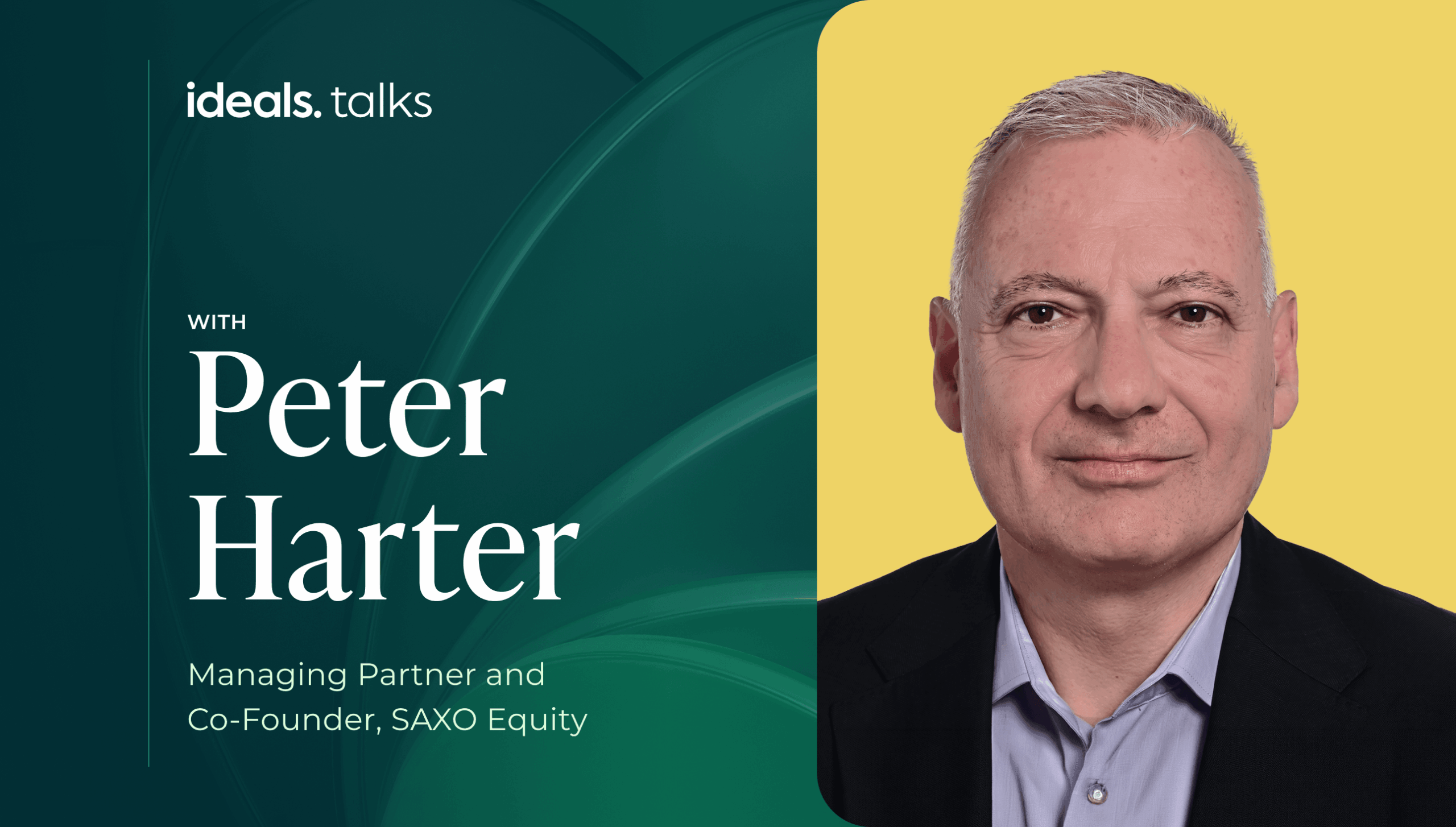
Technology, Media, and Telecoms (TMT) was the most active sector for German M&A in 2025, driven by the AI boom and the need for digital transformation, according to HSF Kramer.
I spoke with Peter Harter, Managing Partner and Co-Founder of SAXO Equity, an independent M&A advisory firm focused exclusively on the German IT sector, to get his perspective on how this market is evolving.
Peter shared what acquirers look for in a technology company today, how AI is reshaping valuations, and the challenge of deciding when the time is right to exit.
Q. Can you walk me through your career and what led you to specialize in tech M&A?
My background was an MBA, then four years as an auditor at PwC. After that I joined a partnership bringing tech companies to the Neuer Markt, a Frankfurt stock exchange segment launched to list high-growth technology companies, similar in concept to the NASDAQ.
It was right at the start of the dot-com boom and this kind of advisory work had never really been done before in the German market. We brought deep financial expertise and strong connections within the German software industry and built the rest as we went along.
When the Neuer Markt collapsed after the dot-com crash, the IPO pipeline dried up overnight. We had built our network of companies and investors and learned how to value a business, so M&A was the logical next step. I co-founded SAXO Equity in 2003 as an M&A advisory firm for the IT sector, and that has been our focus since.
Q. What does a typical SAXO Equity mandate look like?
Around 90% of our clients are owner-led businesses, and the typical transaction size is €5 to €20 million. Our edge is a database we have built over many years and long-standing relationships with founders and investors.
Most of the people we work with have known SAXO Equity as a specialist for more than 10 years. They are not looking for a large brand name. They want a firm where the partners are on the same level as them, in age and experience, and have spent over 20 years building deep market knowledge.
Alongside our core advisory work, we provide deal sourcing for financial and strategic investors, drawing on our database of around 10,000 IT companies in Germany. Many of those companies are not actively aiming for a sale, but they are open to a conversation if the right investor comes knocking.
In the last three years, the majority of interested parties in our transactions have been financial investors, specifically buy-and-build platforms. They are often a very good fit for clients who are looking for a new entrepreneurial challenge and are open to reinvesting alongside the platform.
Q. What are acquirers looking for in a technology company today?
Our preferred benchmark is always the Rule of 40. If a company can show a combined revenue growth rate and EBITDA margin that meets or exceeds 40, that’s the sweet spot. We prioritize mandates that meet that threshold, and those are the transactions that run smoothly even in the current challenging market environment.
For companies that do not hit that bar, the transaction dynamic changes. They typically become add-ons to existing platforms or for strategic investors, valued for their specialist teams, specific technology, or vertical sector focus. These are smaller, more targeted deals.
Since we started out, the most significant change is competition. 10 to 15 years ago, we were one of very few specialist advisors in Germany focused exclusively on IT, and there were virtually no Germany-based pure-play software investors active in the market.
Today, most M&A advisors have moved into tech M&A, and competition has increased significantly. The market now includes more than 100 advisory firms in the same space (including many former IT entrepreneurs working as independent M&A advisors), as well as over 100 PE investors and family offices.
Q. What do tech founders tend to underestimate when preparing to sell?
What many tech founders underestimate is that exit readiness must be built well before a process starts. A successful transaction is not just about finding an interested buyer. It’s about preparing the company properly, creating competitive tension, and building a broad enough pool of credible buyers or investors.
Data room preparation is also one of those tasks that founders tend to underestimate. It is not especially complex, but it takes discipline and is easy to postpone. Even with AI tools available, someone still has to locate, compile, and organize the relevant documentation, and that initial effort is a bigger challenge than people expect.
The overarching issue is valuation. Software valuations have declined for three years in a row, while many founders are still anchored to valuation levels that were realistic in 2022. Closing that gap is one of the hardest parts of our job right now.
My approach is to make the discussion more objective, rather than tell someone their number is wrong. I ask founders what valuation they are aiming for and then show them the KPIs their company would need to support that valuation.
Often, they realize that it may still be too early for the valuation they have in mind. But waiting also carries real risk. Valuations may not be higher in two years, and they could easily be lower, particularly if the company does not deliver the growth and margin improvement it expects. In this market, very few companies can assume a straight-line growth path.
Q. How do you see tech M&A evolving over the next few years, particularly with the rise of AI?
This year is about learning. All parties – buyers, sellers, and advisors – are working out what AI means for valuations and business models. We see a substantial decline in M&A-activities after the SaaS-pocalypse, following the Claude release in February. This is particularly clear in software, where buyers continue to grapple with how to value companies whose revenue base may be disrupted.
I think 2027 will be the first year where we have a clearer picture. By then the market will have sorted companies into winners, losers, and question marks.
The winners will be software companies that have embedded AI into their products in a way that meaningfully increases productivity for their customers, while also using AI internally to improve their own efficiency. The same will be true for services businesses that have successfully used AI agents to make their delivery model more scalable. The losers will be companies whose customers have repriced the work downward, because AI has made it possible to do the same thing for less.
There’s also a demographic factor independent of all this. Most of the founders we work with are in their 50s and 60s, and many look at the AI transformation and say this is not their world anymore.
A few years ago, maybe 25% of our mandates were driven by the age of the founder. Today, it is closer to 75%, driven by a wave of boomer-generation founders reaching the point where they are ready to exit.
Q. How is SAXO Equity adapting to AI internally?
Around 20%-30% of our resources are now focused on AI automation of our own processes. We have already developed several AI agents to support market research and the preparation of sales materials, including information memoranda and pitch documents.
The next step is to automate parts of due diligence and data room preparation. Ultimately, we want to scale the business more efficiently, without adding resources at the same rate.
The key question for us, and one that mirrors the challenge many of our clients are facing, is how pricing will evolve as AI enables us to deliver more with fewer resources. Clients are already asking whether traditional fee structures will still be appropriate as AI takes on a larger share of the process.
What we do know is that not adapting is not an option. If we don’t keep pace, we will become less competitive.
Q. After more than two decades in the market, what still makes this work interesting to you?
What still surprises me is how much the founder determines the outcome. We have watched entrepreneurs start companies in the same market, with the same offering, at the same time, and the range of results is remarkable. One builds a team of 30 people. Another builds a company of 300 employees. The difference is almost entirely the founder.
What excites me right now is seeing which founders are successfully navigating the AI transformation. The companies that are genuinely integrating AI into their operations and their software, rather than simply mentioning it on their website, are the ones investors are looking for and the mandates we want to represent.
These companies tend to be the winners in terms of growth, profitability, and premium valuations, and they are more likely to be on the right side of what is coming.