


Best M&A Data Rooms in 2026: Top Providers Compared

Table of contents
An M&A data room is a secure online workspace where buyers, sellers, advisors, and legal teams exchange confidential documents during mergers and acquisitions. A purpose-built virtual data room helps deal teams manage access, Q&A, audit trails, and document review more safely than email or generic cloud storage.
The need for reliable M&A virtual data room software is increasing as deal activity recovers. According to BCG’s 2026 M&A Outlook, global M&A value reached $3.0 trillion in 2025, up 31% from the previous year, while deal volumes stayed broadly stable. PwC’s 2026 Global M&A Industry Trends also reported that global deal values increased 36% in 2025, driven largely by megadeals.
This guide compares seven m&a data room providers in 2026: Ideals VDR, Datasite, Intralinks, Ansarada, DealRoom, Firmex, and ShareVault. It is written for sellers, buyers, corporate development teams, investment bankers, M&A advisors, private equity firms, and legal teams, comparing security, pricing models, reviews, support, and deal-specific features.
What is an M&A data room?
An M&A data room is a virtual platform for storing, organizing, sharing, and reviewing confidential documents during mergers and acquisitions. It gives authorized users controlled access to financial records, legal documents, contracts, HR files, intellectual property records, operational data, and other materials needed for due diligence.
A mergers and acquisitions data room differs from generic cloud storage because it is built for controlled external review. Deal teams use it to assign granular permissions, restrict downloads, watermark files, track activity, manage Q&A, and maintain audit trails. These controls matter when multiple bidders, advisors, lawyers, and internal stakeholders need access to different levels of sensitive information.
In practical terms, a data room mergers and acquisitions workflow helps sellers prepare materials before going to market, supports buyers during due diligence, and keeps a record of who accessed which documents throughout the process.

Ideals prioritizes robust security, offering features such as advanced encryption, customizable access permissions, watermarks, and two-factor authentication to ensure that sensitive information remains fully protected throughout the transaction process.
What sets Ideals apart is its exceptional customer care, with multilingual support available 24/7 to assist teams in real time during critical deal stages.
M&A VDR vs. generic cloud storage
| Area | M&A virtual data room | Generic cloud storage |
| Security controls | Built for confidential deal documents, with encryption, MFA, watermarking, view-only access, and access expiry | Usually built for general file storage and collaboration |
| Audit trail | Tracks user activity, document views, downloads, and permission changes | Often limited or less deal-specific |
| Q&A workflow | Structured Q&A modules, question routing, status tracking, and exportable logs | Usually handled through comments, email, or separate spreadsheets |
| Permission granularity | User groups, folder-level and document-level access, read/print/download restrictions | Broader sharing settings, often less granular |
| Compliance support | Designed for regulated and high-risk document exchange | Depends on product and plan |
| Pricing model | Often quote-based, storage-based, per-project, subscription, or per-page | Usually, a per-user or storage-based subscription |
Why do M&A dealmakers need virtual data rooms?
Pre-marketing phase
In the pre-marketing phase, sellers prepare the data room before buyer outreach begins. A structured VDR lets the sell-side team organize key materials, close document gaps, and control when sensitive information becomes visible to potential bidders.
This is especially important for M&A sell-side processes, where several buyers may review different documents at different stages. The right data room helps sellers move quickly without giving every bidder the same level of access too early.
Due diligence phase
During due diligence, buyers, advisors, and legal teams review the target company’s financial, legal, commercial, tax, HR, IT, and operational information. A dedicated due diligence data room helps manage document requests, Q&A, user permissions, audit trails, and bidder activity within a single controlled workspace.
This phase is where VDR quality matters most. Slow uploads, weak search, unclear permissions, or poor Q&A workflows can delay review and create unnecessary risk.
Post-merger integration phase
After closing, the data room can support post-merger integration by keeping transaction records, signed documents, diligence findings, integration plans, and transition materials organized. Legal, finance, HR, IT, and operations teams can use the archive to verify decisions, track obligations, and support follow-up work after the deal closes.
Quick summary: best M&A data rooms in 2026
G2 ratings and review counts were checked in May 2026 and may change over time.
| Name | Best for | Pricing model | Free trial | G2 rating | Key strength |
| Ideals VDR | Sell-side M&A, due diligence, multi-party review, secure deal management | Usage-based; Core, Premier, Enterprise plans | Free trial available | 4.7/5 on G2 (819 reviews) | 24/7 multilingual support, granular permissions, reporting, engagement analytics |
| Datasite | Large M&A, investment banking, enterprise due diligence | Custom pricing | Free preparation access up to 90 days | 4.4/5 (397 reviews) | Enterprise M&A workflows, AI redaction, Q&A, large-document handling |
| Intralinks | Enterprise M&A, regulated deal workflows, high-security document exchange | Quote-based | Demo/quote request | 3.8/5 (30 reviews) | Long-established VDR brand, permissioning, IRM, transaction security |
| Ansarada | M&A preparation, capital raising, deal readiness, AI-assisted workflows | Subscription / quote-based | Start for free/free preparation | 4.5/5 (238 reviews) | AI-assisted deal preparation, bidder engagement insights, Q&A |
| DealRoom | M&A project management plus VDR workflows | Flat-rate plans based on deal volume | Demo / sales-led access | 4.3/5 (66 reviews) | Diligence request management, task tracking, M&A workflow centralization |
| Firmex | Mid-market M&A, legal diligence, recurring deal teams | Single-project or subscription pricing | Demo/free trial via sales | 4.6/5 (93 reviews) | Practical VDR workflows, activity reporting, 24/7/365 support |
| ShareVault | Mid-market M&A, life sciences, PE, investment banking, secure external sharing | Flexible pricing based on needs | 15-day free trial | 4.6/5 (92 reviews) | Security, document control, 24/7 support, life sciences and M&A fit |
7 best M&A data rooms in 2026
Ideals VDR
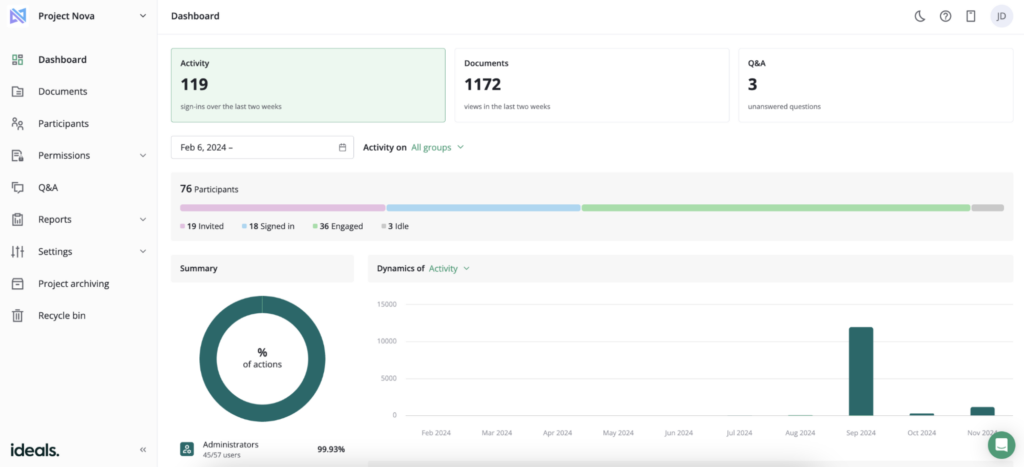
Ideals VDR is a secure virtual data room built for M&A, due diligence, fundraising, real estate, life sciences, and other confidential document workflows. For M&A teams, it is most relevant when several external parties need controlled access to different folders, documents, and Q&A workstreams.
Ideals is a strong fit for sell-side teams preparing a structured diligence process, buyers reviewing sensitive target information, and advisors who need fast setup, reporting, and responsive support. The platform is also relevant for virtual data room m&a workflows where non-technical users need to upload, review, and manage documents without slowing down the deal.
A key differentiator is support. Ideals states on its customer support page that support is available 24/7/365 in 13 languages, with live chat assisting in over 50 languages. Its pricing page also lists Core, Premier, and Enterprise plans, including unlimited users across plans and features such as custom reports, document translation, external storage upload, multi-project management, SSO, and API integration, depending on the plan.
Best for:
Ideals is best for M&A teams that need granular access control, structured due diligence, Q&A, reporting, and responsive multilingual support. It is especially relevant for sell-side preparation, advisor-led diligence, and multi-party review.
Key features
- Granular permissions and controlled external access
- Q&A workflow for bidder and advisor questions
- Reporting and engagement analytics
- Dynamic watermarks and document protection
- AI-powered redaction and document management features
- 24/7 multilingual support
Pricing:
Ideals uses transparent usage-based pricing with Core, Premier, and Enterprise plans. Public pricing pages describe Core for small to medium deals, Premier for larger or more complex transactions, and Enterprise for high-volume deal pipelines and multi-project management.
Free trial/demo:
Ideals offers a free trial.
G2 rating:
Ideals has a 4.7/5 rating on G2. G2 reviews highlight ease of use, permission settings, audit logs, document protection, engagement insights, and strong support, while some users mention pricing or learning-curve considerations.
Reddit reviews:
One VDR thread describes Ideals as having “strong audit trails” and “granular permissions.” Treat this Reddit thread on virtual data room software as community feedback rather than verified review data.
Pros
- Strong fit for structured M&A diligence and external review
- 24/7 multilingual support
- Granular permissions, reporting, Q&A, and auditability
Cons
- Some advanced features depend on the selected plan
Datasite
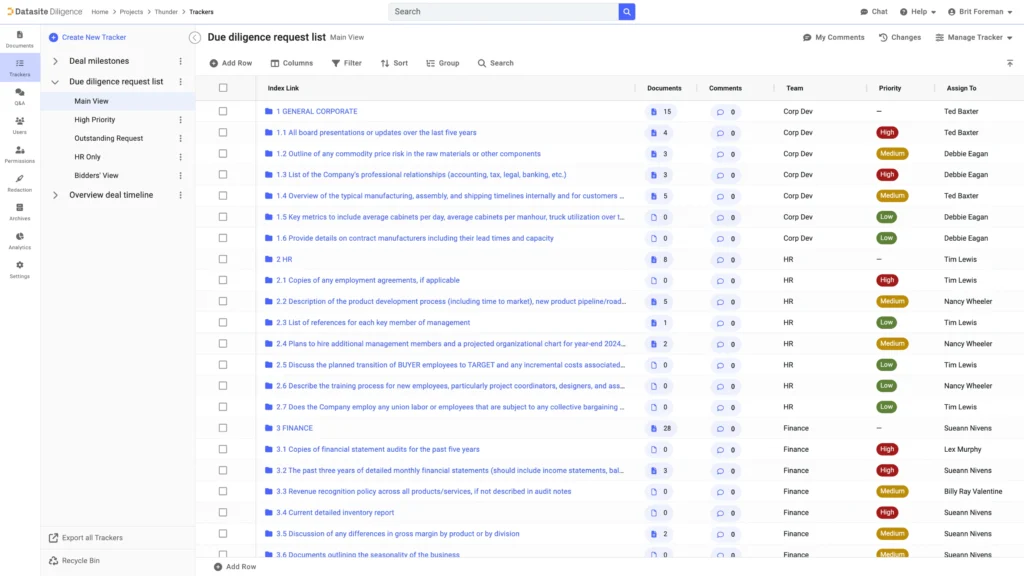
Datasite is an enterprise M&A platform used for due diligence, restructuring, capital raising, and large transaction workflows. Its website positions Datasite as a platform for managing the full spectrum of financial transactions, including M&A, restructuring, administration, and capital raising.
Datasite is particularly relevant for investment banks, corporate development teams, private equity firms, and legal advisors working on large or complex deals. It is often a better fit for enterprise M&A than for small one-off transactions because the platform is built around complex document volumes, multiple parties, and advisor-led processes.
Best for:
Datasite is best for large M&A transactions, investment banking workflows, and enterprise diligence projects with heavy document volumes and multiple external workstreams.
Key features
- AI-assisted redaction and document preparation
- Q&A workflows
- Permission controls and activity tracking
- Document organization and secure sharing
- Mobile access
- Large-scale due diligence workflows
Pricing:
Datasite does not publish simple self-serve pricing for Datasite Diligence. Pricing is typically custom and should be confirmed with Datasite based on project size, users, document volume, support needs, and deal complexity.
Free trial/demo:
Datasite offers free project preparation access for up to 90 days.
G2 rating:
Datasite has a 4.4/5 seller rating from 397 G2 reviews. G2 reviews frequently mention security, document management, tracking, permissions, and ease of use, while some users report complexity for new users or slower performance with large volumes of documents.
Reddit reviews:
Reddit discussions around Datasite often frame it as a serious M&A platform but raise pricing concerns for smaller deals. One user wrote that clients push back on Datasite “mostly around pricing” in this discussion about Datasite alternatives.
Pros
- Strong fit for enterprise and advisor-led M&A
- Mature due diligence workflows
- Useful for large document volumes and complex permissions
Cons
- Pricing is not transparent on a simple public page
- May be too heavy for small or lower-complexity deals
- New users may need onboarding
Intralinks
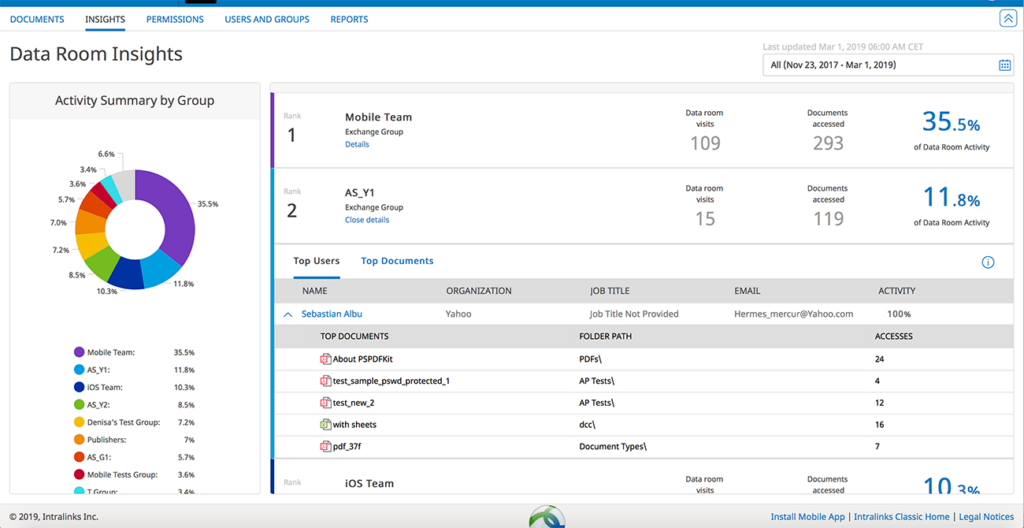
Intralinks VDRPro is a long-established virtual data room platform for M&A, due diligence, fundraising, investor reporting, and secure document exchange. Intralinks says VDRPro helps teams securely share confidential information with potential buyers, advisors, and partners through a single centralized solution.
Intralinks is most relevant for enterprise dealmakers, financial institutions, and regulated transaction teams that prioritize security, permissioning, and a familiar legacy VDR brand. Its product materials emphasize secure document exchange, advanced permissioning, and transaction-focused workflows.
Best for:
Intralinks is best for enterprise M&A, regulated deal workflows, and teams that need a long-established VDR with strong permissioning and transaction security.
Key features
- Advanced permissioning
- Information Rights Management
- Audit tracking
- Secure document exchange
- Mobile access
- M&A and due diligence workflows
Pricing:
Intralinks uses quote-based pricing for VDRPro. Public pages focus on requesting a demo or quote rather than self-serve pricing.
Free trial/demo:
Intralinks offers sales-led demo options. Confirm whether a VDRPro trial is available directly with Intralinks.
G2 rating:
Intralinks VDRPro has a 3.8/5 rating from 30 reviews, with users discussing confidential transaction management, version control, document sharing, traceability, and investor or client collaboration.
Reddit reviews:
Reddit discussions mention Intralinks as one of several established VDRs for controlled access and watermarking, but users also describe established VDRs such as Intralinks, ShareVault, and Ansarada as “super expensive” for smaller use cases. See this Reddit discussion about VDR options.
Pros
- Established VDR brand for enterprise M&A
- Strong security and permissioning
- Suitable for regulated and high-stakes transactions
Cons
- Quote-based pricing
- May feel expensive for smaller teams
- Some users report setup or interface friction
Ansarada
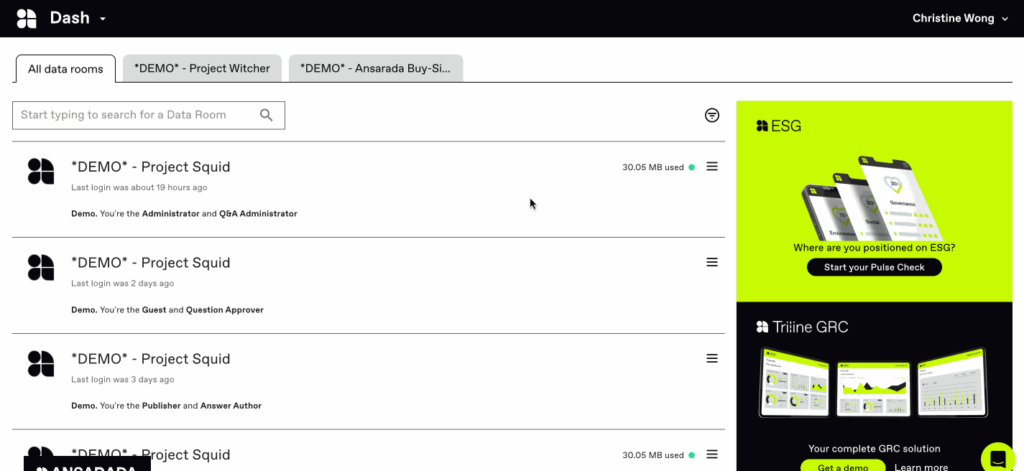
Ansarada is an AI-powered data room and deal platform for M&A, capital raising, restructures, infrastructure procurement, and due diligence. Its website positions the platform as an “AI data room designed for deals” and includes M&A, capital raising, restructures, and infrastructure procurement among its core use cases.
Ansarada is relevant for deal teams that want a structured preparation workflow before launching a live M&A or fundraising process. Its help center says free preparation starts from the subscription creation date and gives access to the full suite of tools before the deal goes live.
Best for:
Ansarada is best for M&A teams that value deal preparation, AI-assisted workflows, Q&A, and bidder engagement insights before and during diligence.
Key features
- Free preparation before deal launch
- AI-assisted document sorting and insights
- Bidder engagement analytics
- Q&A workflows
- Secure permissions
- Deal readiness tools
Pricing:
Ansarada uses subscription-style pricing and online quote flows. Pricing depends on data room setup, storage, and transaction requirements.
Free trial/demo:
Ansarada offers free access and free preparation before the deal goes live.
G2 rating:
Ansarada has a 4.5/5 rating from 238 G2 reviews. G2 users mention security, Q&A, document management, and permissions, while some users criticize usability, cost, and performance.
Reddit reviews:
Reddit discussion on VDRs mentions Ansarada among established tools for access control and watermarking, but also groups it with providers that may feel expensive for smaller or simpler use cases. See this Reddit discussion about Datasite and VDR alternatives.
Pros
- Useful free preparation phase
- Strong AI and deal-readiness positioning
- Good fit for M&A, capital raising, and structured diligence
Cons
- Pricing depends on quote/subscription setup
- May be heavier than needed for simple deals
- Some users report usability and performance concerns
DealRoom
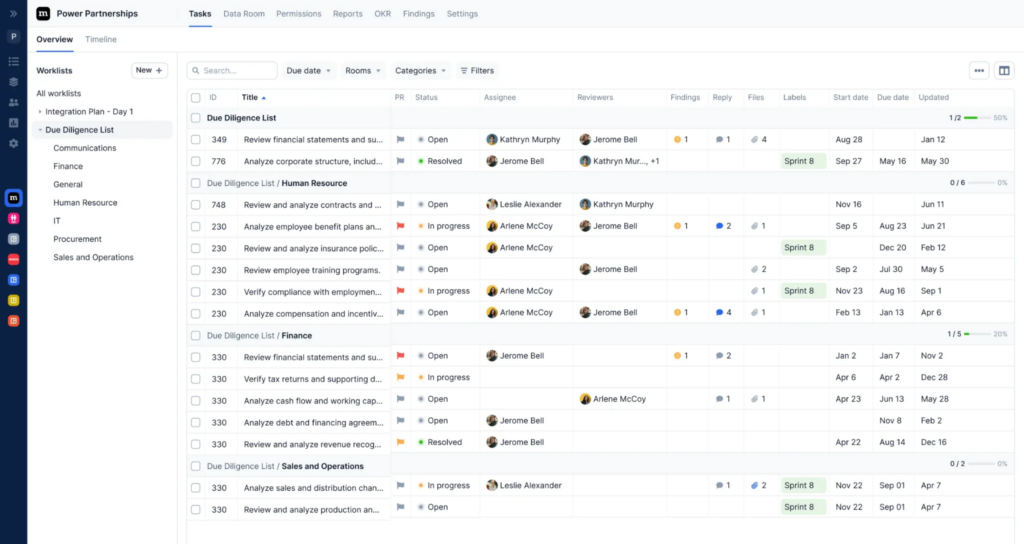
DealRoom is an M&A platform that combines virtual data room functionality with diligence request management, task tracking, workflow collaboration, and pipeline features. Its official pricing page says plans are based on deal volume and include unlimited users and data storage, rather than per-page or per-seat pricing.
DealRoom is most relevant when a team wants the VDR to integrate with a broader M&A project management system. This makes it distinct from traditional file-repository VDRs, as it focuses heavily on diligence requests, workstream visibility, and collaboration.
Best for:
DealRoom is best for corporate development teams, investment banks, private equity teams, and M&A advisors who want project management and diligence tracking built into the same workspace as the VDR.
Key features
- Diligence request management
- Document-specific permissions
- Task and workflow tracking
- Centralized collaboration
- Document management
- M&A pipeline features
Pricing:
DealRoom uses flat-rate plans based on deal volume, with unlimited users and data storage included.
Free trial/demo:
DealRoom offers sales-led access and demos. Confirm trial availability directly with DealRoom before publication.
G2 rating:
DealRoom has a 4.3/5 rating from 66 reviews on G2. G2 reviews highlight ease of use, organization, document-specific permissions, and due-diligence task management, while some users note friction with notifications.
Reddit reviews:
One Reddit discussion says DealRoom is “purpose-built for M&A task and workflow management,” especially for teams running multiple deals. Another thread notes that DealRoom is easy to set up but can become expensive. See this Reddit thread about tested VDRs.
Pros
- Strong M&A workflow and task-management fit
- Flat-rate pricing model with unlimited users and storage
- Good for teams managing diligence lists and workstreams
Cons
- May be more workflow-heavy than teams needing only a document room
- Pricing can still be high depending on deal volume
- Some users may need process adoption across deal teams
Firmex
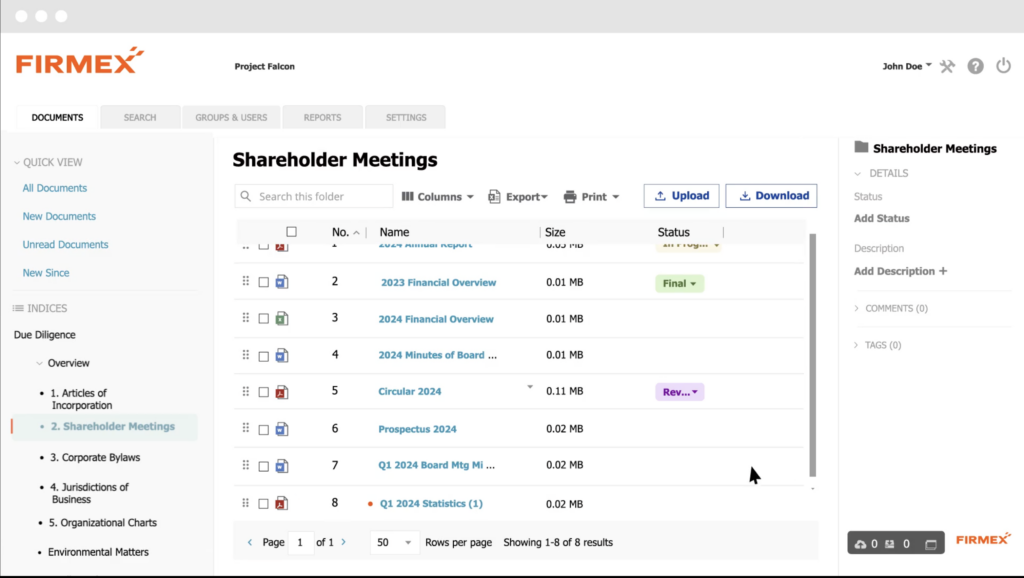
Firmex is a purpose-built virtual data room provider used for M&A, due diligence, compliance, litigation, and secure document exchange. Its pricing page says Firmex offers single-project data rooms and subscriptions, with subscriptions positioned as more affordable for teams doing more than one deal per year.
Firmex is relevant for mid-market M&A, legal diligence, private equity, and recurring corporate finance workflows. It is often positioned as a practical VDR rather than a broader M&A project management platform.
Best for:
Firmex is best for mid-market M&A teams, legal advisors, corporate finance teams, and private equity users who need a reliable VDR with project or subscription pricing.
Key features
- Secure document sharing
- Q&A workflows
- Audit trails and activity reporting
- Advanced document controls
- Support for recurring deal teams
- Single-project and subscription options
Pricing:
Firmex offers single-project pricing and subscription pricing. Its official site says subscriptions can be more affordable than equivalent single-project data rooms for teams that do more than one deal per year.
Free trial/demo:
Firmex invites users to contact the team for a demo, free trial, and pricing information. G2 pricing materials also indicate free-trial editions, with final costs negotiated with the seller.
G2 rating:
Firmex has a 4.6/5 rating on G2.
Reddit reviews:
Reddit discussion describes Firmex as an “industry veteran” with a proven track record in M&A and due diligence, while also noting that the interface can feel dated compared with newer tools. See this Reddit thread about VDRs tested for startup due diligence.
Pros
- Strong fit for mid-market and recurring deal teams
- Single-project and subscription pricing options
- Practical VDR workflows without excessive complexity
Cons
- Public pricing is quote-based
- Interface may feel less modern than newer tools
- Advanced customization may be limited compared with some competitors
ShareVault
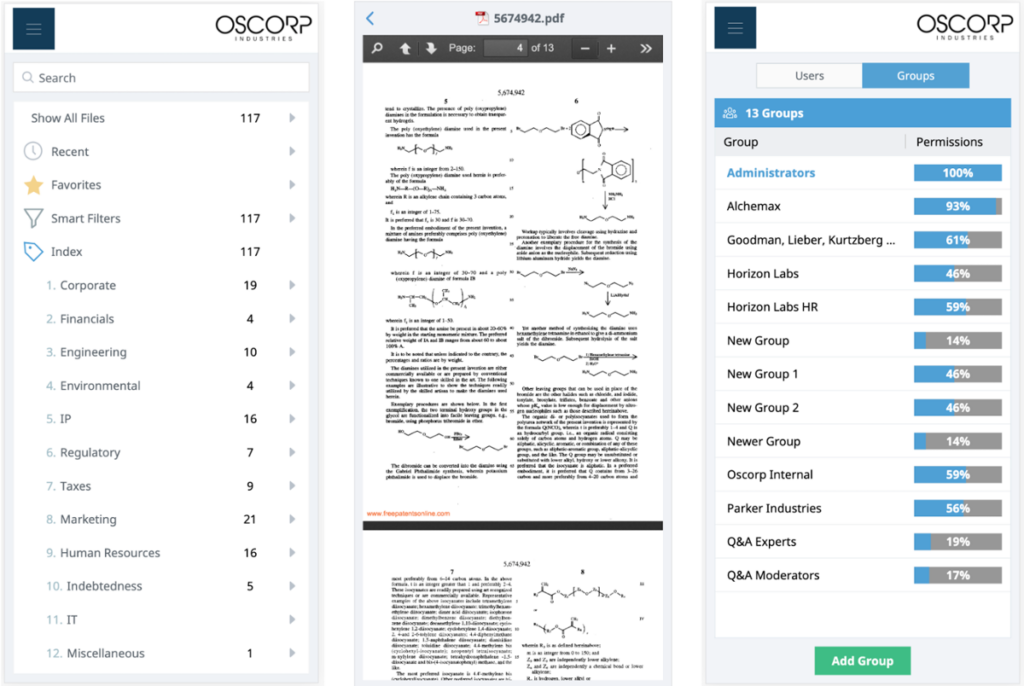
ShareVault is a virtual data room provider used for M&A, asset sales, fundraising, licensing, partnering, life sciences, private equity, investment banking, legal services, and real estate. Its G2 profile describes ShareVault as a VDR used by companies, VCs, investment bankers, law firms, and accountants for due diligence.
ShareVault’s pricing page says pricing is flexible and based on the features and storage a business needs. The company also advertises a 15-day free trial, 30-day money-back guarantee, same-day deployment, mobile access, secure document sharing, and 24/7 support.
Best for:
ShareVault is best for mid-market M&A, PE, investment banking, life sciences, licensing, and other secure external sharing workflows where document control and support matter.
Key features
- Secure document sharing
- Granular access and activity tracking
- Drag-and-drop organization
- Mobile access
- 24/7 support
- Compliance-oriented security positioning
Pricing:
ShareVault says pricing is based on business needs, features, and storage. Capterra also lists ShareVault pricing with a free trial and no free version.
Free trial/demo:
ShareVault advertises a 15-day free trial, 30-day money-back guarantee, and same-day data room deployment.
G2 rating:
ShareVault has a 4.6/5 rating from 92 G2 reviews. G2 reviewers often mention security, ease of use, document management, and secure sharing, while some note learning difficulty, slow performance, or UI limitations.
Reddit reviews:
Reddit discussion mentions ShareVault among VDRs that provide access control and watermarking, but also describes tools in that group as expensive for smaller use cases. See this Reddit discussion about VDR options.
Pros
- Strong, secure sharing and due diligence positioning
- 15-day free trial advertised
- Good fit for mid-market M&A and life sciences workflows
Cons
- Pricing requires contact/quote flow
- Some users report UI or learning-curve issues
- May be more than smaller teams need for simple document exchange
How to choose an M&A data room: key features compared
Security and access controls
The best virtual data room for M&A should include encryption, two-factor authentication, IP restrictions or whitelisting, dynamic watermarks, view-only access, and access expiry. In higher-risk deals, screenshot prevention or screen-shielding features can also help reduce the risk of unauthorized copying.
Security should be evaluated practically, not just by a checklist of certifications. Deal teams should test how permissions work for bidders, advisors, internal users, and late-stage buyers before inviting external parties.
Permission granularity
Permission granularity is critical in M&A because different users should see different documents at different stages. The VDR should support user groups, folder-level and document-level restrictions, read/print/download controls, and time-limited access.
This matters most in competitive auctions, staged diligence, and transactions with sensitive customer, employee, IP, or pricing information. Weak permissions can expose more information than intended.
Q&A workflow
A structured Q&A module helps sellers manage buyer questions without losing context across email threads and spreadsheets. Look for document-level questions, bulk responses, status tracking, question routing, priority labels, and exportable Q&A logs.
In M&A, Q&A quality can directly affect deal speed. A messy Q&A process slows advisors, creates duplicate questions, and increases the risk of inconsistent answers.
Audit trail and reporting
Audit trails should show who viewed, downloaded, printed, or interacted with each document. Strong reporting should include page-level activity, time-spent tracking, bidder engagement, group-level activity, and exports to PDF or Excel.
For sellers, reporting helps identify serious bidders and manage process momentum. For buyers and advisors, audit records can support accountability and help reconstruct what was reviewed during diligence.
AI features
AI features can reduce manual work in document-heavy deals. The most useful M&A features include auto-redaction, smart search, document translation, document summarization, file classification, and deal analytics.
However, deal teams should verify what each AI feature actually does. “AI-powered” can mean anything from search assistance to automated redaction, so buyers should test the feature on real documents before relying on it.
Ease of setup
Deal teams often need a VDR ready before a buyer list is finalized or immediately after an NDA is signed. Useful setup features include drag-and-drop upload, bulk upload, automatic indexing, folder-structure import, and Office-to-PDF conversion.
Ease of setup is not just an admin issue. A poorly structured VDR can slow buyer review and make the seller look less prepared.
Support
Support matters because M&A timelines often run outside normal business hours. Look for 24/7 availability, language coverage, onboarding support, setup assistance, and access to a dedicated project manager for complex deals.
For cross-border deals, multilingual support can reduce delays when buyers, advisors, and counsel work across time zones.
What documents to add to an M&A data room
These are examples of documents to add to an M&A data room. The exact list depends on the transaction type, sector, buyer requests, regulatory context, and deal stage.
Corporate documents
- Articles of incorporation and bylaws
- Shareholder agreements
- Board meeting minutes
- Organizational charts
- Ownership structure
- Subsidiary information
- Corporate approvals and resolutions
Financial records
- Audited financial statements for the last 3–5 years
- Tax returns and filings
- Profit and loss statements
- Balance sheets
- Cash flow statements
- Budget forecasts
- Financial projections
- Debt and financing agreements
Legal documents
- Customer, supplier, vendor, and partnership agreements
- Intellectual property records, including patents, trademarks, and copyrights
- Litigation history and pending legal matters
- Compliance certificates and licenses
- NDAs and confidentiality agreements
- Employment agreements for key staff
- Material lease or property agreements
Operational information
- Employee contracts and benefits plans
- Inventory and supply chain details
- Key operating procedures
- Asset lists, including real estate, equipment, and technology assets
- Insurance policies
- IT systems documentation
- Cybersecurity policies, if relevant
Sales and marketing documents
- Customer contracts
- Sales agreements
- Sales pipeline reports
- Marketing strategies and materials
- Sales performance data
- Customer concentration reports
- Customer churn or retention analysis
Industry-specific documents
- Regulatory approvals for healthcare, energy, finance, or other regulated sectors
- Environmental compliance reports
- Clinical trial documentation, if relevant
- Real estate title, zoning, lease, or property records
- Product certifications
- Sector-specific licenses or permits
Conclusion
The right M&A data room depends on deal size, buyer count, document volume, support needs, and the level of control required over sensitive information. Smaller deals may prioritize fast setup and predictable pricing, while large or regulated transactions usually need deeper permissions, advanced Q&A, audit reporting, and 24/7 support. The best approach is to shortlist providers by deal type, test them with a real folder structure, and verify pricing, security controls, and support availability before the process begins.
FAQ
The best virtual data room for M&A depends on the transaction type, document volume, buyer count, and support needs. Ideals VDR is a strong fit for structured M&A due diligence and multilingual support; Datasite and Intralinks are well-suited to large enterprise deals; DealRoom is strong for M&A project management; and Firmex or ShareVault may suit mid-market transactions.
M&A data room costs vary by provider, storage capacity, number of users, project duration, support level, and pricing model. Common models include quote-based pricing, per-page pricing, storage-based pricing, flat-fee pricing, and subscriptions. Always confirm storage limits, admin limits, overage rules, project-extension fees, and support costs before signing.
A VDR is built for confidential external review during transactions, whereas SharePoint and Google Drive are general collaboration or file storage tools. M&A VDRs usually offer stronger deal-specific controls, such as granular permissions, watermarks, audit trails, Q&A, view-only access, access expiry, and bidder reporting.
An M&A data room should include encryption, two-factor authentication, granular permissions, dynamic watermarks, audit trails, access expiry, view-only mode, Q&A controls, and detailed reporting. For sensitive or regulated deals, also check certifications and compliance support, such as ISO 27001, SOC 2, GDPR-related controls, and industry-specific requirements.
A free data room or free file-sharing tool may work for early document collection or low-risk internal preparation, but it is usually not enough for active M&A due diligence. For buyer review, use a purpose-built VDR with strong permissions, audit trails, Q&A, watermarking, and support.
A basic M&A data room can be set up quickly if the folder structure and documents are ready. More complex deals may require additional time to build the index, clean up files, configure permissions, test user roles, prepare Q&A workflows, and train internal users before inviting bidders.