


Best IPO data rooms in 2026: Top 5 providers compared

Table of contents
Choosing an IPO data room is a deal-timeline decision, not a procurement one. Filing windows narrow, underwriter counsel works to a clock, and any friction in document review can push a pricing date by weeks. The platform sitting between issuer, underwriters, auditors, and legal counsel has to handle high-volume document review, multi-party permissioning, and SEC-grade audit trails without becoming the bottleneck.
The market context is favorable. According to EY’s Global IPO Trends report,1,293 IPOs raised $171.8 billion globally in 2025, with proceeds up 39% year on year, and Q4 2025 was the strongest quarter for global IPO volumes since Q4 2022. EY also points to a potential AI-led mega-wave of listings in 2026. For companies in that pipeline, the virtual data room is no longer a back-office tool, it’s the document control layer the entire offering runs through.
This guide compares five IPO data room providers on the criteria that actually matter during an offering: security and compliance features, pricing transparency, free trial availability, G2 reviews, and how well each handles IPO-specific workflows such as SEC filing integration and underwriter access control.
What is an IPO data room?
An IPO data room is a secure online repository for managing the confidential documents shared during the registration, due diligence, and pricing phases of an initial public offering. The issuer’s finance, legal, and corporate development teams use it to upload and organize materials. Underwriters and their counsel use it to conduct diligence. Auditors use it to access supporting documents and audit evidence related to the financial statements. External counsel reviews legal and IP filings inside it. In some workflows, controlled document subsets may be shared with external reviewers; formal regulatory submissions usually move through filing systems such as EDGAR or local equivalents.
What an IPO virtual data room enables that generic file sharing does not: granular permissioning down to document and folder level, dynamic watermarking on every viewed page, full audit logs of who accessed what and when, secure Q&A workflows that keep underwriter questions and management responses inside the room, and can support controls relevant to SOC 2 Type II, ISO 27001, and GDPR compliance. They are how the issuer demonstrates that confidential pre-IPO information was handled in a defensible way.
Why an IPO data room matters: 4 IPO-specific benefits
The general case for a VDR is well covered elsewhere. The IPO-specific case narrows to four points:
- IPO filing support and document-control management. Draft registration statements (S-1 or equivalent), prospectus drafts, and supporting exhibits move through many revisions during an offering. A data room organized by category keeps the working file authoritative and traceable, which matters when the SEC requests redlines or supporting documentation.
- Multi-party access control. A typical IPO involves the issuer, lead and co-managing underwriters, underwriter counsel, issuer counsel, auditors, and selected external advisors. Each group needs scoped access to different materials. Group-level permissioning that scales without breaking is the operational floor.
- Due diligence acceleration. Underwriter diligence is often one of the most document-intensive phases of an IPO. Indexed documents, full-text search across the document set, and structured Q&A reduce the number of back-and-forth emails and shorten the path from kickoff to comfort letter.
- Compliance-grade audit trail. Every view, download, print, and Q&A exchange should generate a timestamped audit-log entry, where supported by the platform and permission settings. If a confidentiality question arises later — for example, in connection with selective disclosure rules — the audit trail is the evidence record.
Quick summary: best IPO data rooms in 2026
| Provider | Best for | Pricing model | Free trial | G2 rating | IPO-specific strength |
| Ideals VDR | Mid-market to enterprise IPOs that need fast setup, transparent pricing, and 24/7 multilingual support | Usage-based | Yes | 4.7/5 (819 reviews) | Eight-level granular permissions, 15-minute setup, named G2 Best Software for 4 consecutive years |
| Datasite Diligence | Large-cap IPOs and investment banks managing concurrent offerings where institutional credibility matters | Customized (quote-based) | No | 4.4/5 (397 reviews) | AI-powered redaction and indexing built around the M&A and IPO workflow at scale |
| Intralinks VDRPro | Enterprise, cross-border IPOs, where information rights management and post-download control are non-negotiable | Quote-based custom | No | 3.8/5 (30 reviews) | UNshare IRM technology and 16 permission roles for complex multi-jurisdiction deals |
| Venue by DFIN | IPOs and SEC-regulated offerings where the deal team wants integrated filing tools | Quote-based | No self-serve | 3.8/5 (2 reviews) | Native ActiveDisclosure integration for SEC filings (rebuilt platform launched September 2025) |
| Ansarada | Sellers and issuers who want a free preparation phase before committing to a live data room | Storage-tiered, transparent on website | 14 days | 4.5/5 (238 reviews) | Free preparation phase, AI bidder/reviewer engagement scoring |
5 best IPO data room providers in 2026
1. Ideals VDR
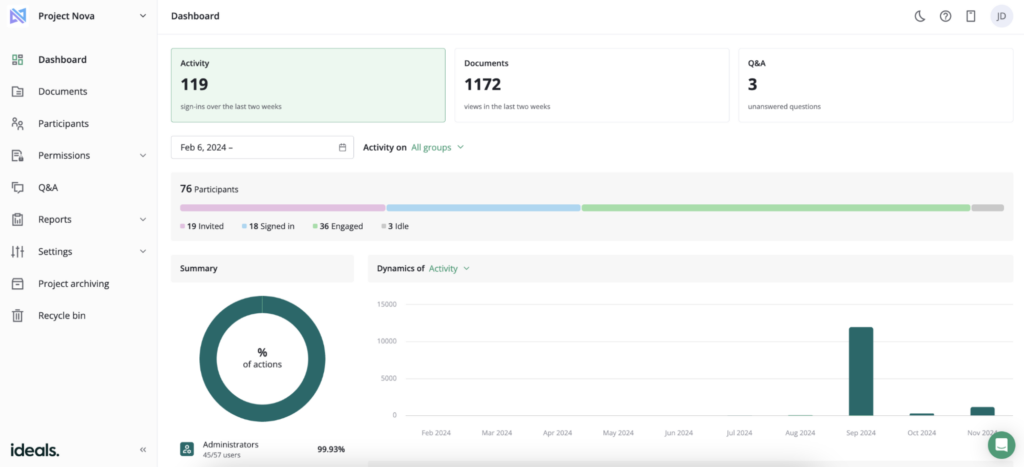
Ideals is a global virtual data room used by issuers, underwriters, investment banks, and corporate development teams for M&A, fundraising, IPOs, and other regulated transactions. It has been independently rated as G2’s Best Software in the VDR category for four consecutive years and currently holds a 4.7/5 average score on the platform. Setup time runs around 15 minutes from kickoff to a structured, permissioned room, and onboarding does not require IT involvement. Support is staffed 24/7 in more than 13 languages, which matters for cross-border offerings with reviewer teams in multiple time zones. For finance leads who do not want to negotiate per-page pricing mid-deal, the platform’s transparent usage-based structure is one of its main draws. Ideals also publishes its full security posture, including SOC 2 Type II, SOC 3, ISO 27001, HIPAA, and GDPR compliance.
Best for mid-market to enterprise IPOs that need a working room set up in under an hour, predictable pricing, and round-the-clock multilingual support without bringing in a dedicated project manager.
Key IPO features:
- Eight levels of granular access control (document, folder, user, group)
- Dynamic watermarking with custom IP, time, and email metadata
- Fence View restricted-viewing mode for highly sensitive disclosures
- Structured Q&A module with question routing and expert assignment
- Full audit trail with exportable reports for compliance review
Pricing. Transparent usage-based model. Pricing tiers (Core, Premier, Enterprise) are tailored to deal size and feature requirements; clients receive a single defined cost rather than per-page billing.
Free trial/demo. Free trial available; live demo available on request.
G2 rating: 4.7/5 on G2 — Best Software in the VDR category for four consecutive years.
User reviews. Cross-platform user feedback aggregated on Trustpilot and G2 highlights fast support response times and the ease of standing up a room under time pressure: one Trustpilot reviewer described a last-minute project as “set up very quickly and with great ease,” with partners connected within days (source).
Pros:
- Fast setup and intuitive interface lower the burden on issuer staff
- Transparent pricing avoids mid-deal page-count surprises
- Strongest user satisfaction scores among the providers in this guide
Cons:
- Some long-term customers have flagged annual price increases on G2
- Default permission settings on new groups could be more restrictive
2. Datasite Diligence
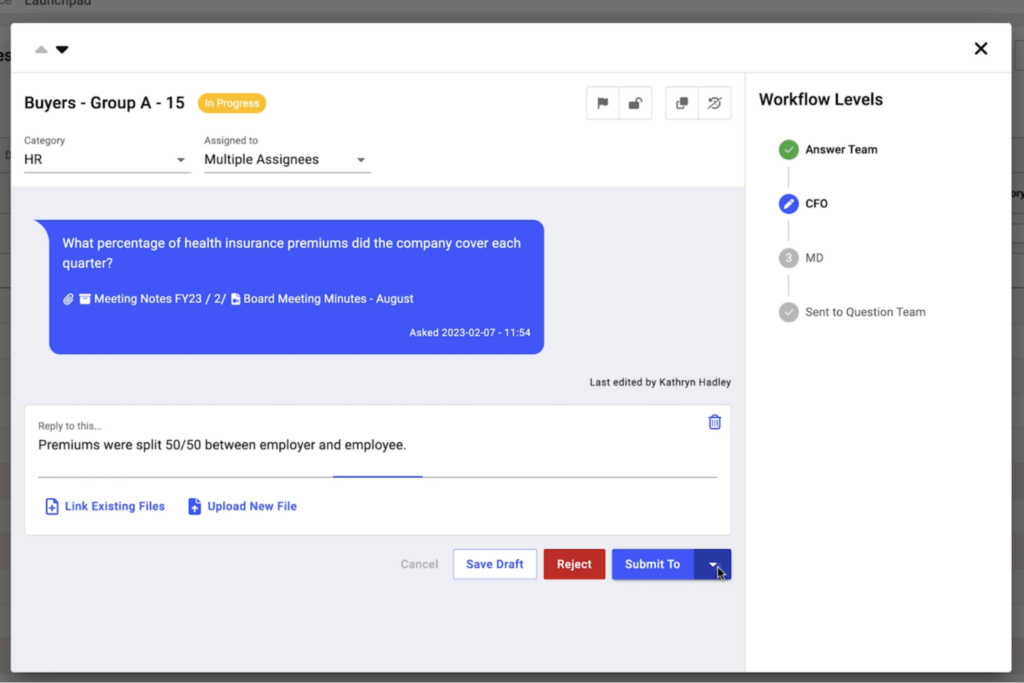
Datasite, formerly Merrill Datasite, is one of the longest-established enterprise VDR providers. The platform is built around large M&A and IPO workflows, with AI-powered features including automated redaction, smart indexing, and machine-learning-based document classification trained on more than three million documents. Datasite operates in 180+ countries with 24/7/365 support in more than 20 languages. Its institutional client base spans investment banks, private equity firms, and large corporates running concurrent offerings.
Best for large-cap IPOs and investment banks running multiple offerings simultaneously, where institutional brand recognition and AI document tooling outweigh budget considerations.
Key IPO features:
- AI-powered redaction with up to 50 customizable terms per fileroom
- Smart indexing and machine-learning-based document categorization
- Granular permission management across multiple bidder or reviewer groups
- Integrated Q&A workflow with advanced routing
- ISO 27001, SOC 2 Type II, and additional security certifications
Pricing. Custom. Total deal cost depends on document volume, user count, and project duration.
Free trial/demo. No public free trial. Custom demos available through sales.
G2 rating: 4.4/5 on G2
User reviews. Aggregated user feedback on G2 consistently highlights the platform’s depth combined with pricing complexity. One Small Business reviewer summarized the tradeoff plainly: “The only con to Datasite is pricing” (G2 review excerpt).
Pros:
- AI redaction and indexing genuinely reduce manual document prep
- Institutional credibility with Fortune 1000 and major investment banks
- Broad security certification set, including ISO 42001 for AI governance
Cons:
- Per-page pricing makes the total cost hard to forecast on document-heavy deals
- Reported slow performance during heavy uploads of large files
- Steep learning curve for first-time administrators
3. Intralinks VDRPro
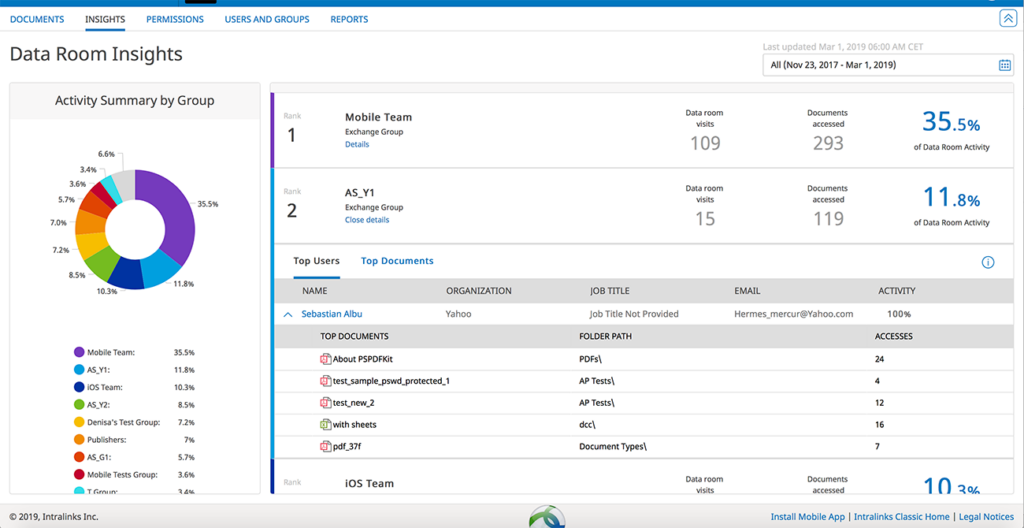
SS&C Intralinks created the virtual data room category more than 20 years ago and remains a fixture in large-cap M&A and capital markets work. The platform is widely used by global investment banks, with its information rights management (IRM) and “remote detonation” features cited as differentiators for post-download document control across multiple jurisdictions. Intralinks was the first VDR to achieve ISO 27701 certification for data privacy. Support is staffed 24/7 in more than 140 languages.
Best for large enterprise IPOs, cross-border offerings, and complex multi-party transactions where information rights management and the ability to revoke access to already-downloaded documents are deal-critical.
Key IPO features:
- UNshare IRM technology for post-download access revocation
- 4 primary user roles paired with 3 document access levels
- AI-powered redaction in VDRPro
- AES 256-bit encryption at rest, 2048-bit RSA in transit, customer-managed keys available
- ISO 27001 and ISO 27701 certifications
Pricing. Quote-based custom. Public-source estimates put a document-heavy 10,000-page project at roughly $7,500. Basic per-user licenses have been reported starting around $25/month. Setup typically takes longer than a week from initial contact to live room.
Free trial/demo. No public free trial. Custom demos through sales.
G2 rating: 3.8/5 on G2. Notably lower than peer providers, primarily on user-experience grounds.
User reviews. Across G2 and aggregator reviews, the most frequent user comments center on the platform’s age and UX: one Lawyer reviewer summarized that Intralinks is “definitely not the most friendly option in the market” (source).
Pros:
- IRM and remote-revocation capabilities are genuinely differentiated
- Strongest fit for cross-border enterprise deals with regulatory requirements
- Established reputation among Fortune 1000 clients
Cons:
- G2 user-experience scores trail the rest of this list
- Setup over a week conflicts with compressed IPO timelines
- Pricing opacity makes budgeting difficult
4. Venue by DFIN
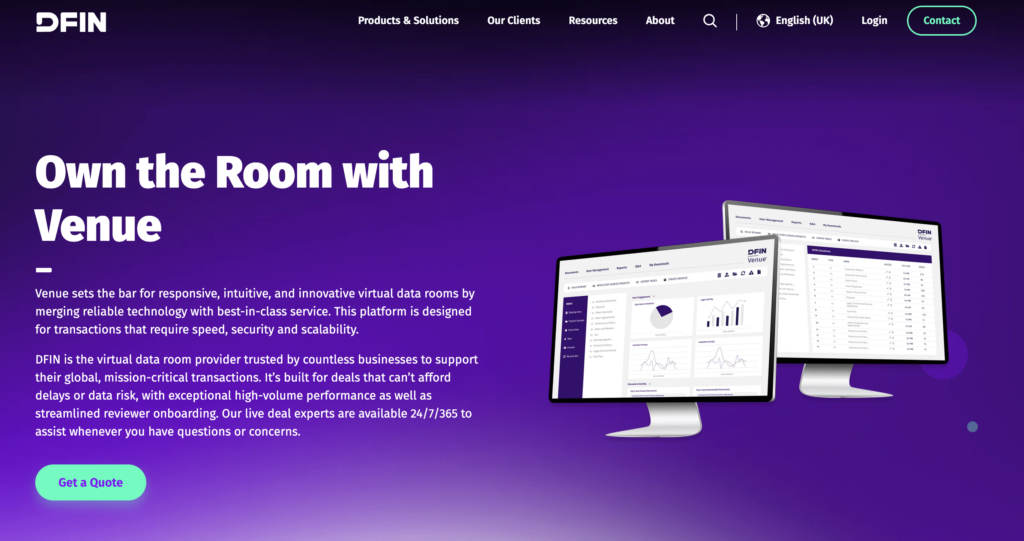
Venue is Donnelley Financial Solutions’ (NYSE: DFIN) virtual data room. DFIN introduced a rebuilt Venue platform on September 24, 2025, with modern architecture, intelligent permissioning, and real-time insights, while the legacy version remains accessible during a phased client migration through 2026. The single feature that makes Venue most relevant for IPO workflows specifically is its native integration with DFIN’s ActiveDisclosure platform for SEC filings. For companies preparing an S-1 or other SEC submission, that single connection can compress days off the final filing prep cycle.
Best for IPO preparation and SEC-regulated transactions where the deal team wants integrated compliance tools and a single-vendor stack. Strong fit for investment banks and law firms already using DFIN products.
Key IPO features:
- Native ActiveDisclosure integration for SEC filings (the most IPO-specific feature among providers in this guide)
- AI-powered bulk redaction in the rebuilt platform
- Real-time viewer insights and engagement analytics
- Self-launch capability for new data rooms, with intuitive permissioning
- ISO 27001, SOC 2 Type 2, SSO, and MFA
Pricing. Quote-based only. User-reported costs put Venue in the premium tier alongside Datasite and Intralinks, with reports of approximately €1,500/month for 1 GB of storage. Historically, per-page pricing (around €0.45/page).
Free trial/demo. No self-serve trial. Demo arranged through sales.
G2 rating: 3.8/5 on G2.
User reviews. Available aggregated reviews on G2 and SoftwareReviews highlight the AI redaction and ActiveDisclosure integration. One reviewer described the AI auto-redaction as the platform’s defining feature: it “significantly reduces the time and effort needed to prepare sensitive documents” (SoftwareReviews).
Pros:
- ActiveDisclosure integration is the most IPO-specific feature in this category
- DFIN’s broader compliance ecosystem reduces vendor sprawl on an IPO
- Public-company parent (DFIN, NYSE-listed) adds institutional stability
Cons:
- Premium pricing makes it unsuitable for smaller offerings
- No self-serve trial means evaluation requires committing to a sales process
- Legacy customers migrating to the rebuilt platform face a learning curve
5. Ansarada
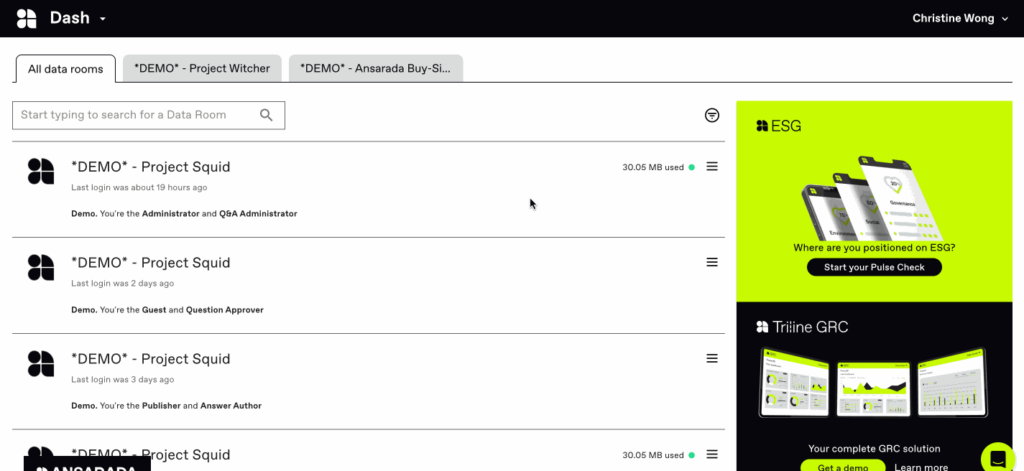
Ansarada is an Australia-founded VDR with a 20-year history in M&A, capital raising, IPOs, and infrastructure procurement, serving clients in 180 countries. The platform was acquired by Datasite in August 2024 for approximately AUD $240 million, but continues to operate as an independent brand. Ansarada’s defining commercial feature is its free preparation phase: the data room is free to set up, organize, and populate until a counterparty is invited in. For issuers running an IPO prep cycle that may stretch over months before the working group is fully assembled, that pre-go-live phase has real practical value. The platform also publishes transparent pricing directly on its website, which is unusual in the category.
Best for issuers and sellers who want to organize their data room well before the underwriter group is fully engaged, and who value transparent monthly pricing over enterprise sales cycles.
Key IPO features:
- Free preparation phase before the data room goes live
- AI bidder/reviewer engagement scoring to flag the most active reviewers
- AI-assisted document organization and bulk redaction (up to 500+ documents)
- Granular user permissions with self-destruct on downloaded files
- ISO 27001 certification
Pricing. Transparent storage-tiered pricing is published on the website. Plans start around $499/month for 250 MB, scaling up to $2,499/month for 4 GB. Larger projects move to custom enterprise quotes.
Free trial/demo. 14-day free trial, plus the free preparation phase before the transaction goes live.
G2 rating: 4.5/5 on G2, 238 reviews on the Ansarada seller page.
User reviews. Available verified reviewer commentary on G2 and Capterra emphasizes ease of use and AI features. One Senior Consultant reviewer noted Ansarada “makes the transaction process more efficient for all parties” (G2 review excerpt).
Pros:
- Free preparation phase is genuinely useful for early-stage IPO readiness
- Transparent on-site pricing avoids opaque sales cycles
- AI engagement scoring offers a different analytics angle than peers
Cons:
- Storage-tiered pricing can produce data-pack overages on larger deals
- Long-term product roadmap uncertainty since the August 2024 Datasite acquisition
- Some reviewers describe the interface as visually dated relative to newer entrants
How to set up an IPO data room: key steps
The setup workflow is broadly the same across providers. What changes is the toolset for each step. These steps are platform-neutral.
- Organize document categories before uploading anything. Map the index against the working group’s document request list and the categories you would expect to appear in an S-1 exhibit list (see the next section for a checklist). Indexing after upload is slower than indexing before.
- Set up user groups and permissions. At minimum: issuer (full access), underwriter counsel, lead underwriter analysts, co-managers, auditors, and external issuer counsel. Apply group-level permissions before adding individual users. Read more on permissioning best practice in our data room due diligence guide.
- Configure the Q&A module. Define question routing so that underwriter questions go to the right subject-matter experts (finance, legal, technical, HR) rather than landing in a single inbox. Set SLAs internally for response time.
- Upload regulatory filings and supporting financials. Draft registration statement, audited financials, MD&A drafts, comfort letter drafts, and legal opinion drafts. Watermark every document and set download permissions according to group.
- Set up audit trail notifications and reviewer alerts. At a minimum, alert on bulk downloads and on first views by named reviewers. These two events typically signal the start of substantive diligence and the points at which selective disclosure questions become most relevant.
- Run a test review. Have a non-deal member of the issuer team attempt to access the room as each group. Verify that permissions actually prevent the access they should prevent. Do this before the underwriter group is invited in.
IPO data room checklist: key documents to include
The exact list varies by jurisdiction, sector, and offering structure, but a working IPO data room typically covers the following categories:
- Corporate structure documents — Certificates of incorporation, bylaws, shareholder agreements, cap table, subsidiary structure charts, foreign qualification documents.
- Financial statements — Three years of audited financial statements (or the maximum available for younger issuers), interim unaudited results, auditor consents, and pro forma statements where required.
- Draft registration statement — Working drafts of Form S-1 for U.S. domestic issuers, Form F-1 for eligible foreign private issuers in a U.S. registered offering, or prospectus/listing documents required under EU, UK, Hong Kong, Indian, or other local regimes.
- Legal and compliance filings — Current and historical litigation, regulatory correspondence, governmental approvals, antitrust filings where applicable, and compliance program documentation.
- Intellectual property — Patent and trademark registrations, IP assignment agreements, licensing agreements, freedom-to-operate analyses.
- Material contracts — Customer contracts above disclosure thresholds, supplier agreements, joint ventures, lease agreements, financing arrangements, indemnification agreements.
- Management bios and org chart — Director and officer biographies, executive employment agreements, equity grants and option plan documents, board minutes for the relevant lookback period.
- Underwriter agreements — Engagement letter, draft underwriting agreement, lock-up agreements, comfort letter drafts, expert consents.
This list is not exhaustive. For a sector-specific offering — biotech, fintech, infrastructure — additional categories such as clinical trial data, regulatory licenses, or concession agreements will be required. Discuss the index with underwriter counsel before populating the room.
Conclusion
The right IPO data room depends on deal complexity, the number of external parties involved, and whether the company needs native integration with regulatory filing platforms. A cross-border, multi-bookrunner deal with strict information rights management requirements tends to favor Intralinks or Datasite. A US offering where SEC filing integration matters most often pulls toward Venue by DFIN. A mid-market IPO that needs to stand up quickly with transparent pricing typically pulls toward Ideals or Ansarada. Evaluate any provider against the actual document volume, reviewer count, and timeline of the offering rather than against general feature comparisons.
Frequently asked questions
What is an IPO data room, and who uses it?
An IPO data room is a secure online repository for managing confidential documents during an initial public offering. The issuer’s finance and legal teams, the lead and co-managing underwriters, underwriter counsel, auditors, and external counsel all use it during registration, due diligence, and pricing. Some workflows also extend controlled access to regulators or rating agencies.
What is the best data room for IPO preparation in 2026?
The “best” depends on the deal profile. Ideals scores highest on G2 for user satisfaction, at 4.7/5, and is well-suited to mid-market IPOs needing fast setup and transparent pricing. Datasite leads the G2 Spring 2025 Grid for VDR overall and is the default for large-cap offerings. Venue by DFIN is the most IPO-specific pick because of its native ActiveDisclosure integration for SEC filings.
How much does an IPO data room cost?
Cost varies widely by pricing model. Per-page providers such as Datasite typically run around $0.60 per page, so a 10,000-page room costs roughly $6,000, and a 200,000-page room can exceed $100,000 annually. Flat-rate providers such as Ideals price by plan tier rather than page count. Ansarada publishes storage-based pricing from $499/month for 250 MB. Quote-based providers (Datasite, Intralinks, Venue) typically require contact with sales for an accurate figure.
What documents should be in an IPO data room?
At minimum: corporate structure documents, three years of audited financial statements, the draft registration statement (S-1 or equivalent), legal and compliance filings, IP registrations, material contracts, management bios and org chart, and underwriter agreements. The full list varies by sector and jurisdiction. See the documents section above for a complete breakdown.
How is an IPO data room different from an M&A data room?
An M&A data room is structured for a single buyer or a pool of competitive bidders to review a target. An IPO data room is structured around underwriter and auditor diligence ahead of a public registration. The IPO version emphasizes SEC-grade audit logging, regulatory filing support, longer pre-go-live preparation windows, and integration with filing platforms; the M&A version emphasizes bidder analytics, deal-specific Q&A, and competitive process management. Many providers support both, but the workflow templates and permission structures differ. For investment-banking-specific workflows, see our VDR for investment banking guide.
Do I need a dedicated VDR for an IPO, or can I use Google Drive?
A dedicated VDR is required in practice. Google Drive does not provide the granular permissioning, dynamic watermarking, full audit trail, Q&A workflow, or compliance certifications (SOC 2 Type II, ISO 27001) that underwriter counsel and auditors expect to see on an IPO. Using consumer file-sharing for pre-IPO confidential material also creates selective disclosure and material nonpublic information exposure that is difficult to defend against if questioned later. The cost of even a premium VDR is small relative to the offering itself.