


Best investment banking data rooms in 2026: Top VDRs compared

Table of contents
Global M&A activity staged its strongest rebound in years in 2025: $4.9 trillion in deal value, up 40% versus 2024 and the second-highest annual total on record, according to Bain & Company’s Global M&A Report 2026. Megadeals worth $5 billion or more drove the surge, and 80% of M&A executives surveyed by Bain expect that pace to continue into 2026.
At that volume, a virtual data room is the operational layer where confidentiality holds or breaks down, where bidder behavior is observed and acted on, and where the bank’s reputation with clients is reinforced or undermined, deal by deal. A data room built for investment banking has to do five things at once: keep multiple concurrent deals isolated, support sell-side and buy-side workflows under different permission structures, handle bidder activity tracking, run a defensible Q&A process across counsel and counterparties, and produce a detailed, exportable audit trail for client, legal, and compliance review. Not every VDR does these equally well.
This article compares the five providers most often shortlisted by investment banking data room teams, M&A advisors, and corporate finance practices in 2026. The reviews cover security depth, multi-project management, Q&A workflow, bidder analytics, pricing model, free trial availability, and what real users report on independent platforms.
What is a virtual data room for investment banking?
A virtual data room investment banking teams rely on is a secure online repository used to share confidential transaction documents with controlled parties: sell-side and buy-side counterparties, target management, advisors, legal teams, accountants, lenders, and institutional investors. The platform manages access through user, group, folder, and document permissions and logs key actions, and provides the workflow tools needed to keep diligence, Q&A, and bidder engagement moving along the deal timeline.
Investment bank data room software supports the full set of transactions bankers work on: sell-side and buy-side M&A, strategic partnerships, debt and equity capital raises, private equity and venture capital deal execution, restructurings, and IPO preparation.
The room is rarely used in isolation. A typical sell-side mandate uses the VDR to support buyer diligence, Q&A management, outside counsel review, target subject-matter experts, and lead banker coordination.
How investment banks use VDRs
Investment banking VDR use cases cluster around six primary deal types. Each has a slightly different access pattern, document set, and permission profile.
Sell-side M&A
On a sell-side M&A mandate, the bank prepares the target’s data set, structures the diligence index, and opens the room to qualified bidders in waves. Each bidder group gets its own permission profile; the bank tracks which documents each prospective buyer engages with most to inform pricing and process strategy. The M&A data room article covers the underlying workflow in more detail.
Buy-side M&A
On a buy-side mandate, the bank advises the acquirer on diligence focus, manages access for its technical and legal advisors, and feeds questions back through the Q&A protocol. Bidder analytics matter less here; what counts is the speed at which counsel and operational reviewers can move through the document set.
Strategic partnerships and joint ventures
Strategic partnership rooms hold the JV term sheet, contributed assets, IP, and IT due diligence, and integration planning documentation. The access list is usually narrow and stable, but document sensitivity is high; persistent rights management and dynamic watermarking matter more than analytics.
Fundraising and capital raises
Debt and equity fundraising rooms hold the pitch deck or information memorandum, financial model, cap table, key contracts, and management bios. Banks track which investors engage with the model versus skimming the deck — data that shapes follow-up sequencing and term-sheet negotiation.
Private equity and venture capital
PE and VC deals run on tight timelines with concentrated bidder pools. The room must handle rapid iteration of permission profiles as bidders drop out and others advance to the second round, while maintaining bidder activity logs that support internal process records, client reporting, and post-close deal documentation.
IPO preparation
For IPO preparation, the VDR may hold draft filings, supporting diligence materials, audited financial statements, material contracts, corporate records, and selected deal-related correspondence. Formal SEC submissions occur through EDGAR, while regulatory review and comments are handled through official SEC filing and correspondence processes. The participant list is broad: lead underwriters and syndicate members, securities counsel, auditors, transfer agents, and other transaction advisors. The room may remain active for several months, while activity logs help support the underwriters’ diligence record and document-review history.
Quick summary: investment banking data room providers compared
The five providers reviewed below are the ones most commonly shortlisted by investment banks and M&A advisors in 2026. The table consolidates positioning, pricing model, free-trial availability, current G2 standing, and the differentiator most relevant to investment-banking workflows. G2 ratings and review counts were verified in May 2026.
| Provider | Best for | Pricing model | Free trial | G2 rating | Key strength for IB |
|---|---|---|---|---|---|
| Ideals | Mid-market and large-cap advisory firms running multiple concurrent deals | Transparent usage-based pricing across 3 plans (Core, Premier, Enterprise) | Full-functionality free trial | 4.7/5 (819 reviews) | 8 permission levels, multi-project hub, 24/7 support in 13 languages |
| Datasite Diligence | Large-cap M&A and IPO advisory at bulge-bracket banks | Custom-quoted | Demo only | 4.5/5 (397 reviews) | AI-assisted redaction and scale for 10,000+ document rooms |
| Intralinks VDRPro | Enterprise banks needing persistent rights management | Quote-based custom | Demo only | 3.8/5 (30 reviews) | IRM controls persist after document download |
| DealRoom | M&A advisory and corporate development teams managing the full deal lifecycle | Flat-rate subscription with unlimited users and storage | Demo only | 4.3/5 (66 reviews) | Purpose-built M&A workflow with pipeline and integration management |
| Firmex | Mid-market advisory firms with high deal frequency | Single-project or unlimited-room subscription | 7-day free trial (1 project) | 4.6/5 (93 reviews) | Predictable subscription pricing; highest support quality rating |
5 best investment banking data rooms in 2026
1. Ideals
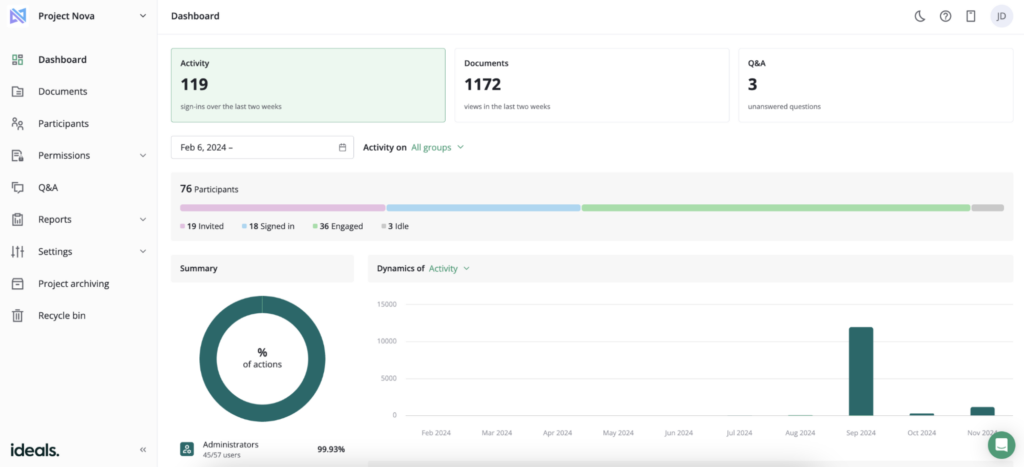
Ideals is a virtual data room used by investment banks, M&A advisors, law firms, and PE/VC firms across global transactions. The platform has been independently rated G2’s top product in the VDR category for four consecutive years, with 819+ reviews on G2 and consistent recognition for support responsiveness and ease of setup.
For investment banking specifically, Ideals’ strength is the combination of an eight-level permission model and a multi-project workspace that lets a deal team manage several live mandates from one place without spinning up separate accounts. Setup is fast — most rooms go live in under a day — and 24/7 support is staffed in 13 languages, with an interface available in 14 languages and an AI live chat covering 50, which matters when a deal is closing across New York, London, and Singapore simultaneously.
Best for: Mid-market and large-cap advisory firms running multiple concurrent deals where multi-project management and granular permissions are operational requirements.
Key features for investment banking:
- Multi-project workspace for managing concurrent deals with deal-level isolation
- Eight permission levels (none, fence view, view, download encrypted PDF, print, download PDF, download original, upload) for sell-side / buy-side / counsel / bidder segregation
- Built-in redaction and Q&A module with role-based routing and FAQ promotion
- Bidder activity tracking with page-level engagement analytics, exportable for client reporting
- Dynamic watermarking, IP whitelisting, MFA, and configurable audit logs
Pricing: Transparent usage-based pricing across Core, Premier, and Enterprise plans. No per-page surcharges or hidden media-file fees.
Free trial: Full-functionality free trial with no initial payment required.
G2 rating: 4.7/5 across 819+ reviews. Highest overall satisfaction score in this comparison.
User feedback: G2 reviewers in investment banking and financial services consistently highlight setup speed, support responsiveness (sub-minute chat response times), and the eight-level permission model. One investment banking reviewer described Ideals as “intuitive product” with “great support from the team”, noting it made M&A collaboration with external partners easier. The most common improvement requests are editable Q&A entries and richer mobile UX.
Pros:
- A multi-project workspace is genuinely differentiated for advisory teams running concurrent mandates
- The eight-level permission model is the deepest in this comparison
- 24/7 multilingual support with sub-minute chat response; rated highest on the support dimension across G2 reviews
Cons:
- Mobile experience may feel less smooth than desktop
- Q&A setup may require extra configuration
2. Datasite Diligence
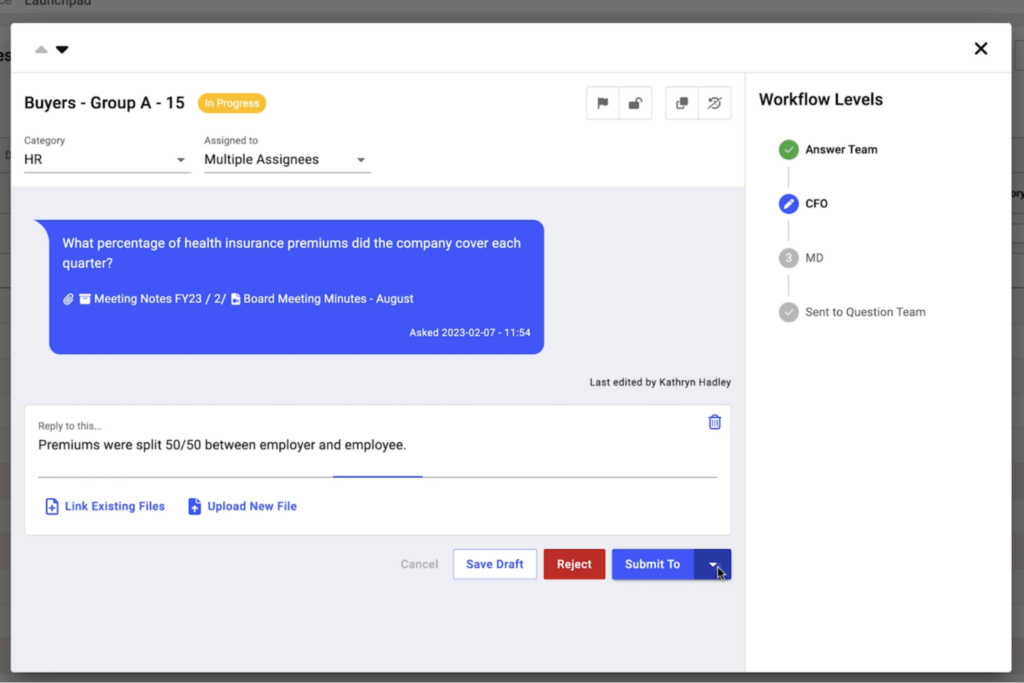
Datasite Diligence is the deal-focused VDR from Datasite, a firm with deep roots in large-cap M&A and IPO workflows. The platform is widely used by bulge-bracket investment banks and law firms running cross-border transactions, with G2 reviews skewed toward enterprise users (40%+ of reviews come from enterprise organizations).
For investment banking, Datasite’s strengths are scale handling — rooms regularly support tens of thousands of documents — and a Q&A module that deal teams describe as a category standard. AI-assisted redaction handles PII at volume on healthcare and financial services deals where personal data is dispersed across the document set. Datasite has also integrated Blueflame AI for secure in-room document interrogation.
Best for: Large-cap M&A and IPO advisory at bulge-bracket banks where Q&A volume runs into the thousands and document scale stretches into five or six figures.
Key features for investment banking:
- AI-assisted redaction for PII at scale with batch processing
- Granular permission roles for buyer, seller, advisor, observer, and counsel groups
- Built-in Q&A module with FAQ promotion, answer export, and threaded discussion
- Real-time activity analytics for bidder and counsel engagement
- Blueflame AI for secure interrogation of document content
Pricing: Custom-quoted. Historically, per-page plus storage and user surcharges, with separate charges for media files and USB archives. Pricing is consistently flagged in G2 reviews as expensive and complex, particularly for smaller deal teams.
Free trial: No self-serve free trial. Guided demo available on request.
G2 rating: 4.5/5 across 397+ reviews.
User feedback: A diligence professional running 100+ transactions a year described Datasite on G2 as “widely considered the best online VDR”. The most consistent G2 criticisms are pricing complexity (30 mentions), slow performance on bulk downloads (31 mentions), and learning difficulty with advanced features (29 mentions).
Pros:
- Scale handling for large-cap deals with 10,000+ documents
- Industry-standard Q&A workflow already familiar to bulge-bracket teams
- AI-assisted redaction reduces manual prep time on PII-heavy deals
Cons:
- Per-page or storage-based pricing makes cost estimates difficult for smaller deals or repeat-mandate firms
- Learning curve flagged for first-time admins; slow performance on bulk downloads
- Media files and USB archive charges are itemized separately
3. Intralinks VDRPro
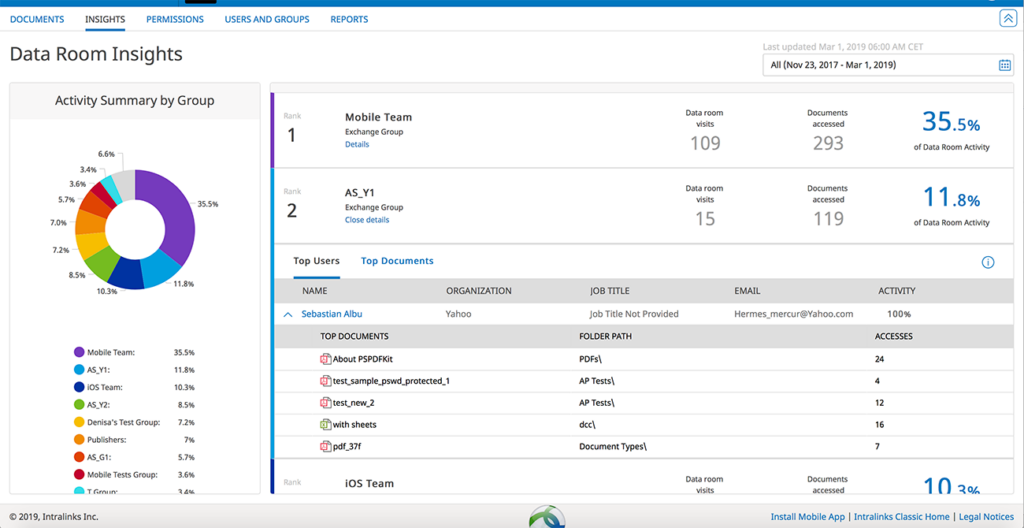
Intralinks (SS&C Intralinks) is one of the oldest VDR providers, having facilitated trillions in financial transactions since the 1990s. For investment banking specifically, its signature feature is Information Rights Management (IRM): controls that persist on documents after they are downloaded, letting administrators revoke access or restrict printing on files already in someone’s possession. That capability is meaningful for sell-side processes where post-close leakage is a real concern.
The trade-off is a dated interface and a longer setup window than modern competitors. Intralinks’ G2 rating is 3.8/5, the lowest in this comparison and well below the platform’s historical reputation among large banks.
Best for: Enterprise banks and regulated cross-border deals where persistent rights management on downloaded documents is a hard requirement.
Key features for investment banking:
- Information Rights Management with post-download access revocation
- 4 primary user roles paired with 3 document access levels
- Multilingual interface and 24/7 global support
- Detailed activity tracking and audit logs
- AI-assisted redaction (more recent addition)
Pricing: Custom-quoted only. Public reports place enterprise rooms in the high-five- to low-six-figure range, with setup typically taking around a week.
Free trial: No self-serve trial; sales-led demo only.
G2 rating: 3.8/5 across 30 reviews, the lowest in this comparison.
User feedback: Cross-platform feedback consistently flags interface dating and plugin friction. In a head-to-head G2 comparison with Datasite, Intralinks scored 8.0 on ease of use versus 8.8 for Datasite. Reddit discussion on r/private_equity includes occasional mentions of Intralinks as the legacy choice that newer evaluators tend to move away from.
Pros:
- IRM controls that persist after download — a genuine differentiator for confidential bidder documents
- Long-established standing with major banks, PE firms, and counsel
- Strong security pedigree across regulated industries
Cons:
- Lowest G2 rating in this comparison; interface widely described as dated
- Plugin requirements for some viewer features create friction for external users on tight deal timelines
- Setup is slower than modern competitors
4. DealRoom
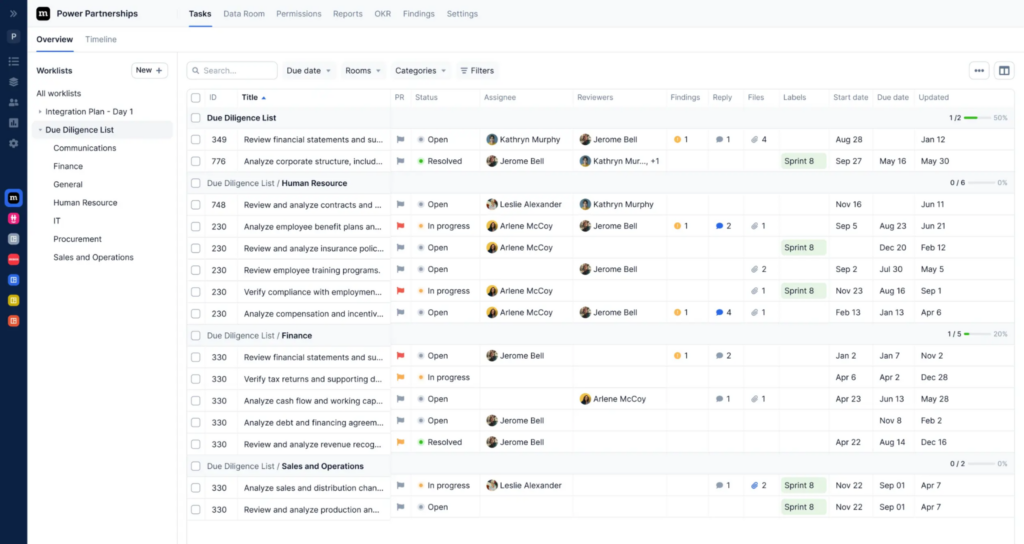
DealRoom is a cloud-based M&A lifecycle platform built specifically for investment banking, private equity, and corporate development teams. It is closer to a deal-operating system than a pure VDR, combining document management with pipeline tracking, diligence-request workflow, and post-merger integration management.
The model rewards teams running a steady deal pipeline rather than one-off transactions: a flat-rate subscription with unlimited users and storage replaces per-page or per-room pricing. About a quarter of DealRoom’s G2 reviewers come from financial services, and another fifth from investment banking specifically — a feedback base that reflects the target audience more closely than most VDRs.
Best for: M&A advisory and corporate development teams managing the full deal lifecycle — from pipeline through diligence to post-close integration — on a predictable flat-rate budget.
Key features for investment banking:
- M&A pipeline management alongside the diligence room — one platform for the deal lifecycle
- Diligence request tracking with automated checklists and assignee management
- Unlimited users and storage on all plans; no per-seat or per-page surcharges
- Document recall, watermarking, granular permissions, and full audit trail
- Post-merger integration planning tools built into the platform
Pricing: Flat-rate subscription billed annually. Standalone VDR product (FirmRoom) is the entry point; lifecycle platform pricing is custom-quoted based on team size and feature set.
Free trial: No self-serve trial; sales-led demo available.
G2 rating: 4.3/5 across 66 reviews.
User feedback: A corporate development reviewer on G2 commented that DealRoom “helps manage multiple deals in parallel” without losing control over documents or communication. Another investment banking analyst noted that “the focus on agile M&A can be a double-edged sword” because the request-based workflow differs from traditional VDR terminology, creating an adoption curve for teams switching from Datasite or Intralinks.
Pros:
- Purpose-built for M&A workflow, not retrofitted from generic document management
- Flat-rate pricing with unlimited users and storage; budget-predictable for high-volume teams
- Pipeline and integration planning tools are unique among VDR providers
Cons:
- Lower G2 review count than Ideals, Datasite, or Firmex; smaller user base for cross-checking
- Interface and terminology differ from traditional VDRs; slower adoption for teams switching from Datasite or Intralinks
- Reporting and export functions less polished than peer platforms, per G2 feedback
5. Firmex
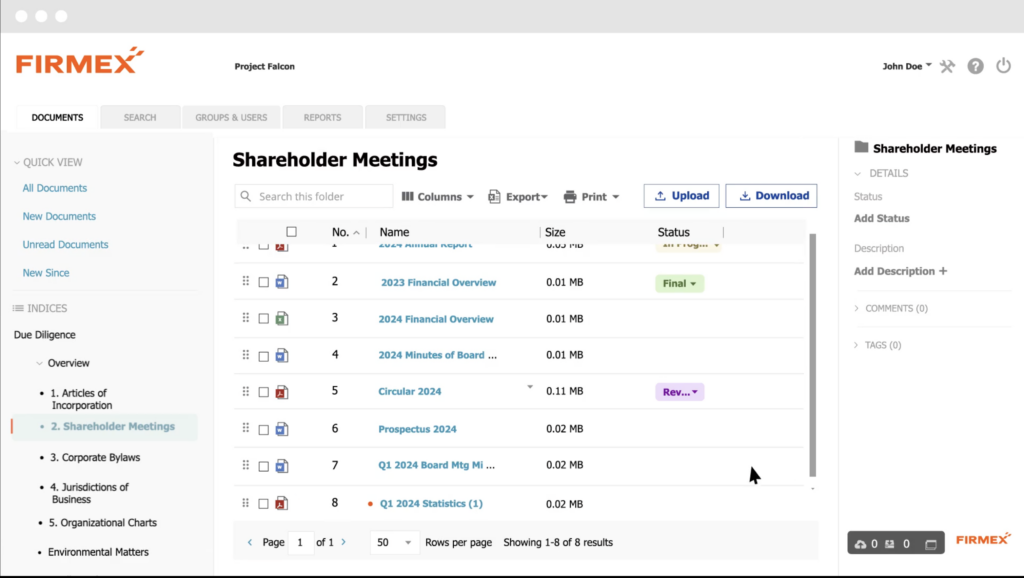
Firmex is a Toronto-based virtual data room provider with a strong presence among mid-market M&A advisors and accounting firms. The platform is consistently rated among the highest-scoring VDRs for ease of use and customer support quality.
For investment banking specifically, Firmex’s differentiator is pricing predictability — a flat-rate unlimited-room subscription that lets mid-market firms with high deal frequency budget without per-page or per-room surprises. The platform is SOC 2, ISO 27001, GDPR, and HIPAA compliant, with SSO, API, and built-in redaction included.
Best for: Mid-market advisory firms with high deal frequency that need predictable subscription pricing and a clean interface for external counterparties.
Key features for investment banking:
- Unlimited-room subscription option with a fixed annual fee regardless of deal volume
- Dynamic watermarking, fence view, granular permissions, and AES-256 encryption
- SOC 2 and ISO 27001 certified; SSO, API, and built-in redaction
- Q&A module with role-based routing
- 24/7 multilingual support (EN, ES, DE, FR) — consistently rated highest in this comparison
Pricing: Per-transaction (one-time fee for a single project) or unlimited-room annual subscription. Pricing on quote; transparent ranges available from the sales team after a brief scoping call.
Free trial: 7-day free trial for one project with unlimited users.
G2 rating: 4.6/5 across 93 reviews.
User feedback: G2 reviewers in mid-market M&A and accounting call out support quality and interface cleanliness; the most common criticism is that the feature set is narrower than Datasite’s or Intralinks’ for the largest enterprise deals. On r/ExperiencedFounders, founders preparing fundraising rooms have flagged Firmex as a sensible pairing with equity tools for cap table and option grant documentation.
Pros:
- Highest support quality rating in this comparison
- Unlimited-room subscription is predictable for mid-market firms running 20+ deals a year
- Clean interface speeds adoption for external counterparties on tight deal timelines
Cons:
- Narrower feature set than enterprise alternatives for the largest cross-border deals
- Reporting customisation flagged as an area for improvement by reviewers
- No multi-project workspace on the scale of Ideals or DealRoom’s pipeline tools
How to choose an investment banking data room: key features compared
Choosing an investment banking VDR is not about ticking a feature list; it is about matching the platform to the bank’s deal volume, client profile, and operational workflow. Six decisions tend to settle most evaluations.
Security depth
At minimum, the platform should offer dynamic watermarking, fence view (screen-capture deterrence), document redaction, multi-factor authentication, and IP whitelisting. For sell-side mandates where post-close leakage is a real concern, persistent rights management (Intralinks IRM, Ideals encrypted downloads) adds a layer that survives the download. When the bank holds multiple clients’ confidential data in adjacent rooms, deal-level isolation is non-negotiable; one breach should not expose other engagements.
Multi-project management
A bank running five concurrent mandates does not want five disconnected logins. Look for a multi-project workspace that lets the deal team manage all live rooms from a single account, with deal-level permission isolation and cross-deal user management. Ideals and DealRoom lead this category; Datasite and Intralinks offer the capability, but with a heavier setup. Firmex’s unlimited-room subscription is the workaround at the subscription layer rather than the UI layer.
Q&A workflow
A useful Q&A is structured, threaded, and assigned. Questions get routed to the subject-matter expert (legal, financial, technical) on the target side; answers are reviewed by counsel before posting; FAQs are promoted so multiple bidders see the same answer to a common question. A chat feature is not a Q&A workflow. Ask vendors to walk through assignment, escalation, and audit-trail features specifically.
Bidder activity tracking and engagement analytics
Bidder analytics tell a sell-side banker which documents each prospective buyer is engaging with, how long they spend on each, and which pages they return to. That data shapes process strategy, second-round pricing, and term-sheet negotiation. Ask vendors what granularity their analytics produce: document-level views and downloads are baseline; page-level heatmaps and time-on-page data are the differentiator.
Ease of bulk upload and document indexing
Deal timelines do not allow slow room setup. The platform should support drag-and-drop bulk upload, automatic folder structure based on a folder hierarchy, OCR for scanned documents, and full-text search across the indexed document set. Ask the vendor how long a 5,000-document room takes to stand up from scratch; that benchmark separates the modern platforms from the legacy ones.
Support quality
Deals close at 11 pm. They close on weekends. They close in different time zones. 24/7 support is the baseline; multilingual coverage matters when the deal involves European or Asian counterparties. Documented response time SLAs are the differentiator. Firmex and Ideals consistently lead this category in third-party review data; Ideals specifically offers customer support in 13 languages, an interface in 14 languages, and AI live chat in 50.
Conclusion
The best data room for investment banking depends on deal volume, client confidentiality requirements, and whether the bank needs a multi-project workspace or single-deal VDR access. Bulge-bracket and large-cap advisory teams running cross-border transactions tend to standardize on Datasite or Intralinks despite the pricing premium. Mid-market and growth-stage advisory firms running 10–100 deals a year benefit more from platforms with multi-project workspaces (Ideals), purpose-built M&A workflow (DealRoom), or unlimited-room subscriptions (Firmex). Whichever platform makes the shortlist, stress-test the audit log and Q&A workflow against actual deal documents before signing; those two checks expose more than any vendor demo.
Frequently asked questions
What is the best data room for investment banking in 2026?
There is no single best data room for investment banking — the right choice depends on deal volume and client mix. For large-cap and IPO mandates at bulge-bracket banks, Datasite and Intralinks are category fixtures. For mid-market and growth-stage advisory firms running multiple concurrent deals, Ideals leads on multi-project management, transparent usage-based pricing, and support response. For M&A teams that want pipeline management alongside the VDR, DealRoom is purpose-built. For mid-market firms with high deal frequency on a predictable budget, Firmex’s unlimited-room subscription is the strongest fit.
How much does an investment banking data room cost?
Investment banking VDR cost varies widely by pricing model. Per-page legacy pricing (Datasite, Intralinks) can push large rooms into the high-five- or low-six-figure range for the full deal window. Storage-based and flat-rate models typically run from a few thousand to several thousand dollars per month. Ideals uses transparent usage-based pricing across three plans (Core, Premier, Enterprise) with no per-page surcharges; DealRoom’s flat-rate plan includes unlimited users and storage; Firmex offers per-transaction pricing for single deals or an unlimited-room annual subscription. Most providers quote rather than publish; total cost depends on storage, contract length, and whether AI features are included.
What features should an investment banking VDR have?
At minimum: granular permission roles, dynamic watermarking, fence view, document redaction, MFA, and IP whitelisting. For investment banking specifically: a structured Q&A workflow with role-based assignment, bidder activity tracking with page-level analytics, multi-project management (for advisory teams running concurrent mandates), bulk upload with OCR and full-text search, and a defensible audit trail that can be exported for client and regulatory review.
Can investment banks manage multiple deals in one data room?
Yes, but the platform needs to be set up for it. A multi-project workspace lets a deal team manage several live mandates from a single account with deal-level permission isolation. Ideals and DealRoom are purpose-built for this pattern. Datasite and Intralinks can support concurrent deals, but typically require separate rooms and additional administrative overhead. Firmex’s workaround is the unlimited-room subscription, which removes pricing friction even though each deal still gets its own room.
How is an investment banking data room different from a regular VDR?
A regular VDR provides secure document storage, access control, and audit logging suitable for routine business use. An investment banking VDR adds workflow features specific to deal execution: a structured Q&A module with role-based routing, bidder activity tracking with engagement analytics, multi-project management for concurrent mandates, persistent rights management on downloaded documents, and audit trails exportable for client, legal, compliance, and internal review. The platform also has to handle the access patterns of M&A deals, in which bidder groups enter and exit on different timelines and with varying permission profiles.
What do investment bankers look for when choosing a VDR?
Bankers prioritize five factors in roughly this order: deal-level isolation between concurrent client engagements, Q&A workflow that can handle hundreds of questions across multiple counterparties, bidder activity tracking that informs process strategy, support availability and response time across time zones, and pricing predictability across deal volume. Brand recognition with institutional counterparties is a secondary factor; some buyers and lenders specifically request Datasite or Intralinks based on familiarity.