


How dealmakers are using AI to gain an edge in M&A: New research

M&A deals are high-stakes, complex, and governed by tight timelines. Artificial intelligence promises to simplify these challenges, helping teams work more efficiently while focusing on the strategic decisions that drive successful transactions. But where is AI making the biggest difference today?
Our latest research, AI in M&A 2026: Expert perspectives on how dealmaking is evolving, surveyed over 100 professionals and interviewed leaders across investment banking, private equity, corporate development, and AI technology firms. The goal was to understand how deal teams are using AI and which parts of the M&A lifecycle are seeing the most significant change.
This is a snapshot of our findings. The full report provides detailed examples and frontline insights from dealmakers.
AI adoption is growing but uneven
Two-thirds of M&A professionals are already using AI or automation tools. The most common applications include document review, deal sourcing, and valuation and financial modeling.
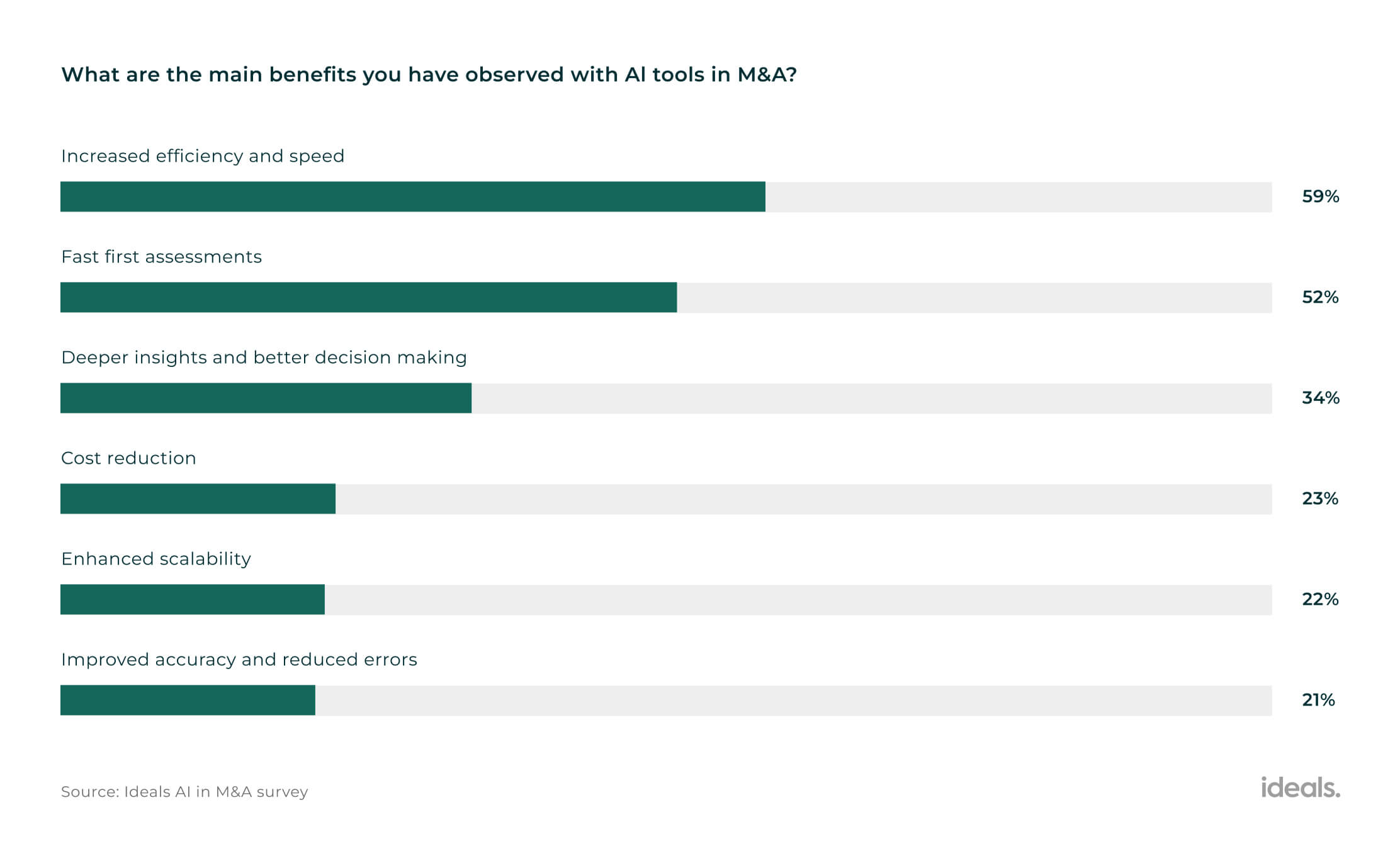
Increased speed and efficiency ranked as AI’s top benefits, followed closely by fast first assessments. Interestingly, improved accuracy did not make the top five, indicating that human oversight remains critical in high-stakes dealmaking.
While AI use is expanding, regional differences highlight how readily dealmakers are implementing the technology. Sabine Schilg, VP of Corporate Development at Ideals, explains:
“Some European dealmakers avoid AI entirely to prevent any compromise of data. In the US, the attitude is more opportunistic. People are less concerned because the productivity gains are so significant.”
This divide has the potential to shape global dealmaking. Research from Boston Consulting Group shows M&A deal volumes in the Americas rose 26% last year, while European activity declined. AI adoption could widen that gap, as US teams benefit from enhanced deal sourcing, screening, and execution.
From deal sourcing to due diligence
As part of the report, we spoke to mid-market dealmakers about how AI helps surface signals that would otherwise be missed. Bethany Winsby, Senior Consultant at Deloitte, says she uses AI to analyze news articles, sector updates, and fragmented public data, allowing her to identify promising opportunities.
“There are countless signals that can be overlooked. AI helps me discover and track these more consistently,” Bethany explains.
We also spoke to a private equity leader who uses AI to scan markets and refine opportunity sets faster. “There are only so many hours in the day,” says Neal Monga, Principal at NMS Capital. “We now focus less on finding opportunities and more on evaluating the ones worth pursuing.”
The benefits of AI are just as evident in due diligence. Document-heavy reviews, once synonymous with late nights in virtual data rooms, are now completed more efficiently. Marta Vizcaíno Martín, a seasoned energy M&A lawyer and now CEO of TetraxAI, an AI-driven platform for diligence, says: “One of the best uses of AI is ending the need for 24/7 document review.”
Marta recalls an energy M&A deal that collapsed the day before closing because trucks could not reach the construction site, a road-access issue that was overlooked during diligence. TetraxAI can identify such risks immediately, enabling teams to address them before they threaten the deal.
Managing AI for maximum impact
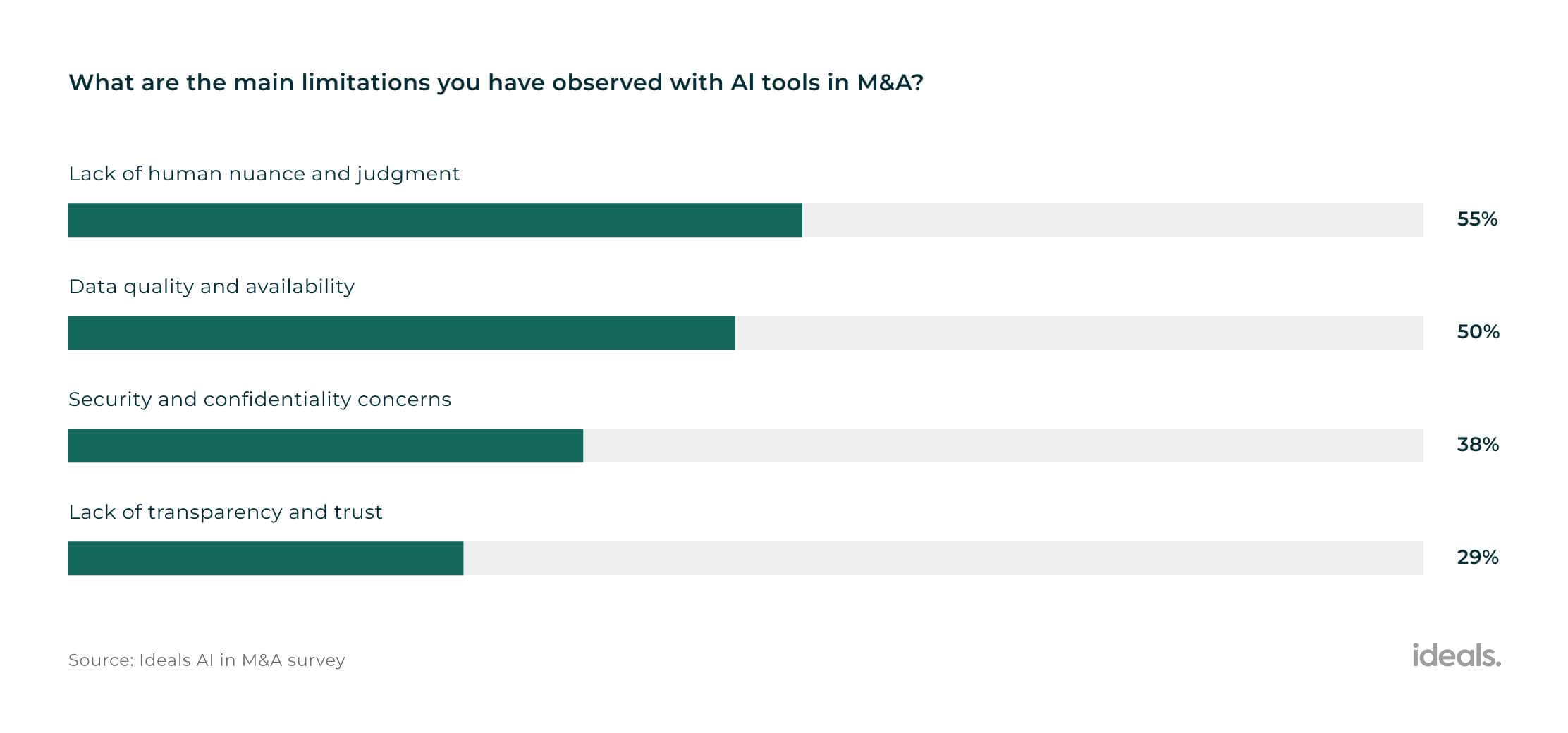
While its use is growing, dealmakers acknowledge the limitations of AI. More than half of our survey respondents cited a lack of human nuance and judgment as the technology’s biggest constraint, followed by concerns around data quality, security, and transparency.
For investment advisors like Emre Ertürk at Odin Financial, a structured use of AI is key to creating value and minimizing risk.
“Too many people treat AI like a black box. The value comes from creating guardrails and training people to use AI in a structured, repeatable way,” he says.
By combining curated datasets with carefully designed prompts, Emre’s team can review thousands of companies, map investors across regions, and build new deal pipelines without losing control over data quality. “Trust but verify is our mantra,” he adds.
The competitive challenge for dealmakers
Bain & Company predicts AI will reshape every stage of M&A within five years, from market sensing to post-close integration. As adoption becomes widespread, speed and efficiency alone will no longer provide a competitive edge. The greatest advantage will go to firms that implement AI strategically, supported by secure practices and well-trained teams.
“It’s clear AI’s role in dealmaking will only grow,” Sabine concludes. “The sooner teams start using it, the faster they’ll learn, and the more value they’ll unlock.”
Explore real-world examples and expert insights in the AI in M&A 2026 report.