


Best due diligence data rooms: top 5 picks

Conducting due diligence without a dedicated data room can make document review slower, harder to control, and riskier for confidential information. A due diligence virtual data room helps solve these problems by giving authorized users a secure, centralized workspace to access, review, organize, and track sensitive documents throughout a transaction.
However, not all VDRs suit every deal. Some are built for large M&A transactions with complex permissions, heavy document volumes, and multiple external reviewers. Others are lighter tools better suited for startup fundraising, investor updates, or smaller business sales. The data-protection features, pricing models, and support levels vary greatly between providers.
This guide explains what a due diligence data room does and how to choose the right provider in 2026. We evaluated the listed platforms based on public product information, G2/Capterra ratings, due diligence use-case fit, pricing transparency, security and permission features, support availability, and available user feedback.
What is a due diligence data room?
A due diligence data room is an organized online space where companies securely store and share important documents during the due diligence process before a business deal, such as a merger or acquisition (M&A). It grants potential buyers or investors controlled access to critical information needed for informed decision-making.
Think of it as a virtual filing cabinet. It houses financial statements, contracts, legal documents, and other sensitive materials that parties need to review. With password protection, access permissions, and built-in activity tracking, the due diligence data room keeps documents confidential, organized, and auditable throughout the process.
In addition to providing protected access to confidential data, a virtual data room for due diligence enables users to do the following:
- Set access permissions and restrictions
- Track and record all user activities
- Control document versions to ensure users have the most up-to-date information
- Ask and answer questions to clarify document content
- Collaborate with other deal participants
- Access files from mobile devices
- Customize the platform to reflect the company’s branding
Read more: What is a due diligence questionnaire?
How to choose a due diligence data room
Selecting a due diligence data room is one of the first real steps in any deal process. Teams typically review multiple providers before committing, and the options can feel overwhelming.
Below are the key questions worth asking before signing a contract.
Does the data room provider have experience working within your industry?
Modern due diligence data room providers offer secure document management, granular permissions, activity tracking, Q&A, and workflow tools. However, the right provider should also understand the specific needs of your industry.
Industry experience can affect how well the VDR supports your workflows, document types, compliance requirements, and review process. When comparing vendors, ask about relevant industry experience, certifications, permission settings, file-format support, reporting capabilities, onboarding, and customer support availability.
The following are the main VDR requirements across common industries.
| Industry | Requirements |
| Financial services | A VDR should support secure document handling, auditability, and access controls for regulated financial-services workflows, including firms subject to FINRA rules in the U.S |
| Biotech | Secure virtual data room may need to support HIPAA-aligned workflows when protected health information is involved, and strict confidentiality controls for clinical trial, R&D, and IP documentation. |
| Energy | Due to the high volume of data shared during energy-sector due diligence, VDRs should support multiple file formats. |
| Legal services | A built-in Q&A module is often useful for coordinating document review, clarifications, and responses across deal parties. |
| IT | Information technology (IT) companies prefer easy-to-use yet secure VDR solutions during their fundraising rounds or M&A deals. |
| Infrastructure | Infrastructure deals often extend beyond initial timelines, making multi-project management and contract extension capabilities essential. |
How much does a due diligence data room cost?
Online data room pricing varies significantly from one provider to another and depends on several factors.
| Factor | Description |
| Data storage capacity | Charges typically apply as overage fees above the plan’s included allocation, ranging from $20 to $75+ per GB, depending on the provider. |
| Number of pages | Some legacy VDR providers use per-page pricing, with fees ranging from $0.40 to $0.85 per page. |
| Number of users | Some data room providers charge based on the number of users. Prices range from $15 to $25 per user. |
| Number of administrators | Administrators responsible for managing and maintaining the data room incur additional costs of $100–$250. |
| Number of workspaces | Some providers include multi-project management in higher-tier plans, while others price by project or workspace. |
| Features | Some providers charge for advanced features like AI-based redaction or analytics. |
| Customer support | In many cases, quality support with 24/7 availability and a dedicated customer manager is included only in higher-priced plans. |
| Flat rate pricing | Clients are charged a fixed fee within agreed-upon user, storage, project, or duration limits, making this model attractive to companies that need to store and share large amounts of data. |
Due diligence data room pricing varies by provider, storage, users, administrators, project duration, support level, and advanced features. Smaller projects may start in the low hundreds per month, while complex enterprise transactions can cost significantly more. Always confirm included storage, user limits, admin limits, extension fees, support costs, and overage rules before signing.
5 best due diligence data room providers in 2026
Now, let’s compare five of the best data rooms for due diligence and their pricing structures.
| Provider | Best for | Free trial | G2 rating |
| Ideals | Complex M&A transactions and investment deals | ✅ | 4.7/5 |
| DealRoom | Managing deal workflows alongside document storage | ❌ | 4.3/5 |
| Ansarada | AI-assisted due diligence and deal preparation | ✅ | 4.5/5 |
| Box | Secure enterprise file sharing with data room features | ✅ | 4.2/5 |
| Papermark | Lightweight document sharing with analytics | ✅ | 4.5/5 |
Ideals VDR
Website: idealsvdr.com
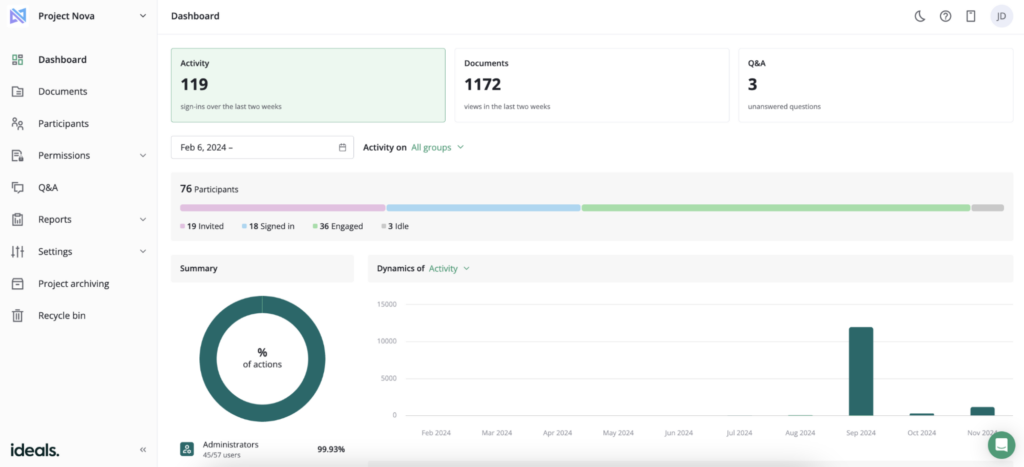
Ideals VDR is designed for complex business transactions, such as M&A, fundraising, restructuring, and real estate deals. The platform focuses on secure document sharing, detailed access control for sensitive projects, and exceptional customer service.
Companies use the platform to organize documents, manage access permissions, and track user activity during due diligence. The system allows administrators to define detailed access levels, set document restrictions, and monitor engagement through audit reports.
Pricing
- Transparent, upfront pricing with no hidden fees
- Quote-based pricing approach
- 7-day free trial
- Three subscription tiers tailored to every business’s needs
- An unlimited number of users with each subscription plan
- Due diligence checklist included with each subscription plan
What Reddit users say
“For my money, Ideals is the safest bet here (strong audit trails, granular permissions, and M&A‑focused features without confusing non‑technical users, which matters more for me personally). Especially when deals get hectic, and you just need everyone in the room to not screw up access or version control.” (source)
“Since last year, we’ve been using Ideals VDR because the pricing was predictable, the permissions were simple and easily controllable, with no learning curve or surprise fees.” (source)
DealRoom
Website: dealroom.net
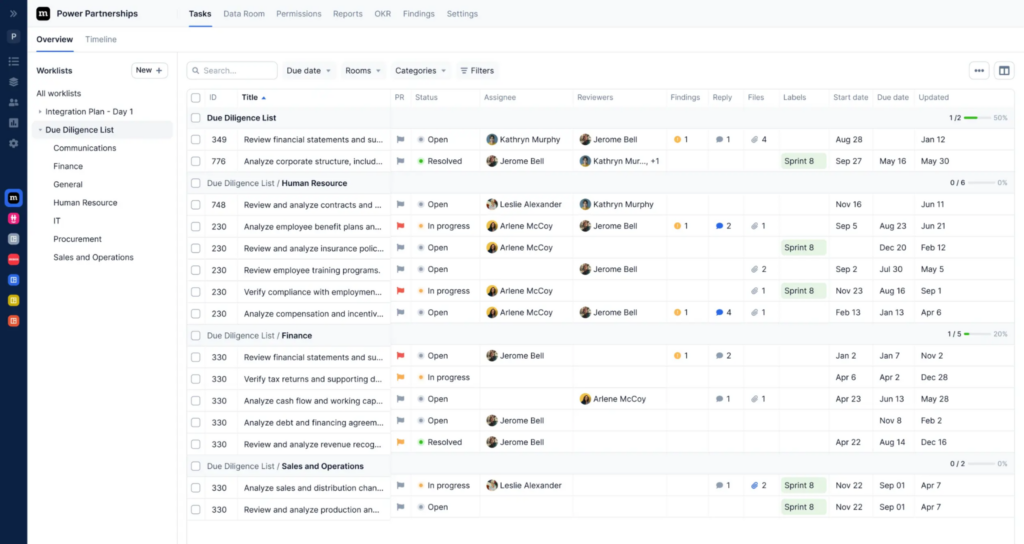
DealRoom is designed for M&A lifecycle management. The platform combines a data room with pipeline tracking, diligence request lists, task management, and post-merger integration tools in a single workspace. This makes it a strong option for corporate development teams running multiple deals simultaneously. However, this provider may potentially be too much if you just need a clean place to share documents for a single transaction.
Pricing
- Deal volume-based pricing
- Unlimited number of users
- No subscription details on the website
- No mention of a free trial
What Reddit users say
“From my research, I really like DealRoom, but it’s too expensive; I won’t be able to sell that to the CFO.” (source)
“Looking at DealRoom, seems like a pretty good option.” (source)
Ansarada
Website: ansarada.com
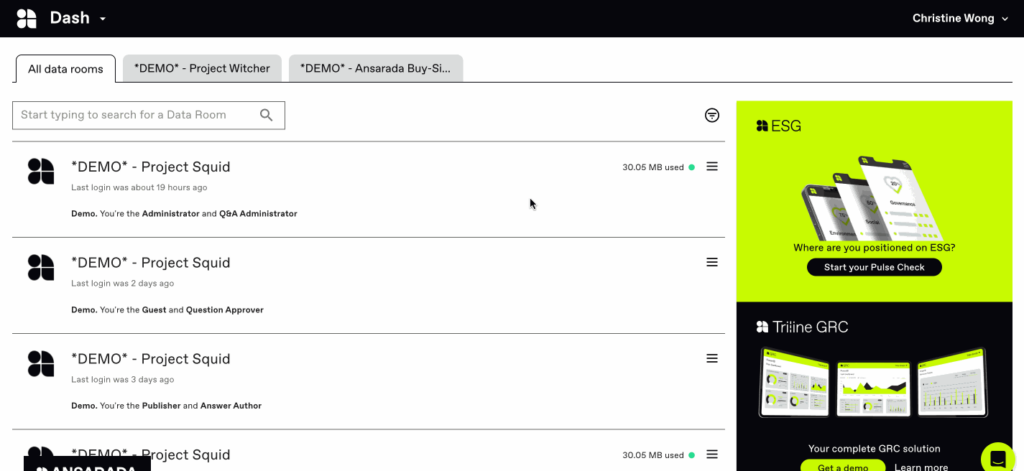
Ansarada deal platform has delivered solutions since 2005. In August 2024, Datasite acquired it for approximately AUD $236.3 million. It continues to operate under its own brand.
What sets Ansarada apart is its AI layer. The platform uses AI to automatically sort and categorize uploaded documents, assess deal readiness, predict bidder engagement, and identify missing materials before external parties gain access.
Pricing
- Transparent pricing approach
- Price starting at $479 per month (250 MB)
- Storage-based pricing model
- Free trial
What Reddit users say
“I’ve had consistently solid runs using Ansarada, mainly because the AI tools actually cut through the noise during diligence instead of just being a gimmick. Makes a huge difference when buyers start firing 100+ questions.” (source)
“We’ve been using Ansarada lately and honestly, the UX is miles ahead of most VDRs, feels a lot more like using an Apple product than a clunky enterprise tool.” (source)
Box
Website: box.com

Box is not a purpose-built VDR. It’s a cloud content management platform used across many industries, including finance, healthcare, and government.
It supports VDR-style capabilities, including customizable access permissions, watermarking, hiding collaborators, retention and disposition features, and integrations. However, buyers should verify plan-specific controls before using it for due diligence.
This makes Box a useful option for larger enterprises that already have Box in their tech stack and want to use it for due diligence rather than switching to a standalone VDR.
Pricing
- 14-day free trial
- Per-user pricing model
- Four subscription Business Plans
- Unlimited storage with all plans
- Business Prices starting at €18 per user/month
What Reddit users say
“Box doesn’t scale super well, especially when you want to start using their API’s.” (source)
“Box is the best ‘lite’ data room, IMO. It lets you share a folder and make it so the recipients can’t see who else it’s been shared with.” (source)
Papermark
Website: papermark.com
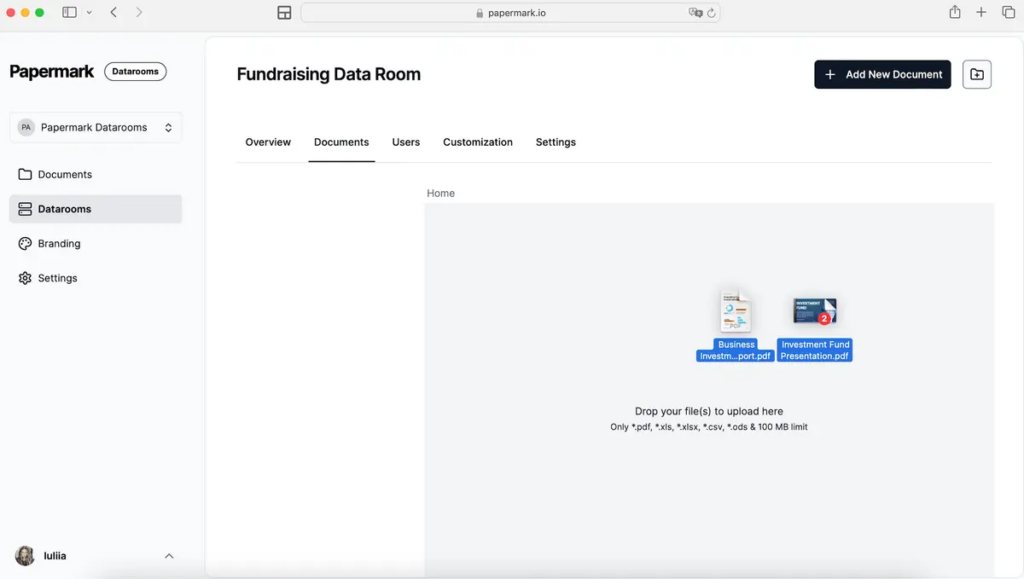
Papermark is a modern document-sharing platform designed to track document engagement. While it is lighter than traditional virtual data room platforms, it offers tools for secure document distribution and analytics.
Users can share documents through links, control access, and monitor how recipients interact with files.
This approach makes Papermark attractive for startups, fundraising, and situations where companies need simple document sharing with visibility into viewer behavior.
Pricing
- Offers a forever-free plan for basic document sharing
- 7-day free trial
- Four Data Rooms subscription plans
- From €149/month (Data Rooms plan)
What Reddit users say
“They’re secure, their tracking for due diligence and audits works amazingly. You can also self-host them. Definitely would recommend them.” (source)
“Papermark is awesome, super reputable, and an amazing option.” (source)
Can a data room vendor provide a due diligence index for your project?
Many industries have regulatory, operational, and documentation requirements that affect how a due diligence data room should be structured. That’s why it’s important to choose a VDR provider that supports automatic indexing, bulk folder-structure import, and document organization tools.
Modern data room providers may also offer due diligence data room checklist or setup support to help deal teams build a clear folder structure, organize required documents, and prepare the data room for buyer, investor, or advisor review.
Due diligence checklists by type:
- Financial (accounting) due diligence. The purpose of conducting due diligence is to investigate a target company’s financial performance, including, for example, reviewing balance sheets, profit and loss statements (P&L), and other supporting financial documents.
- Legal due diligence. Legal due diligence reviews litigation, contracts, corporate records, regulatory compliance, IP ownership, employment matters, and other legal liabilities.
- IT due diligence. IT due diligence reviews the target’s technology architecture, systems, cybersecurity posture, scalability, technical debt, IT costs, and ability to support planned growth.
- Commercial due diligence. Commercial due diligence helps to identify potential opportunities and the company’s position within the industry. Findings are based on the industry’s overall attractiveness and long-term commercial prospects.
- Tax due diligence. Financial statements, tax returns, and audits are examined during tax due diligence. This process identifies a company’s current and potential tax liabilities.
- Operational due diligence. Operational due diligence analyzes how the business operates, including processes, systems, supply chain, facilities, workforce, productivity, and operational risks.
To sum up
Picking a due diligence data room comes down to understanding your deal and your team. There’s no single right answer: What works well for a large M&A process may be overkill for a startup fundraise, and vice versa.
When a free trial is available, test the VDR with your actual folder structure, permission model, reviewer groups, Q&A flow, and reporting needs. That hands-on experience will tell you more than any feature comparison chart.
FAQ
Most corporate IT policies restrict installing unapproved software, which matters during diligence when external buyers, advisors, and counsel need access fast. Advanced due diligence data rooms like Ideals run in the browser with no extra software, so reviewers can be onboarded quickly. Some older platforms still require plugins, so confirm this against your IT policy and the vendor’s setup before a deal kicks off.
Due diligence often runs with several parties at once — lead and follow investors, advisors, opposing counsel — who shouldn’t all see the same materials. Ideals offers eight permission levels for granular, per-group access. For Excel files, administrators control whether users see spreadsheets with or without formulas; for other files, rights span upload, download original, download PDF, print, download encrypted, view, fence view, manage, and restrict.
Knowing how buyers are engaging is part of running the deal, not just admin housekeeping. Ideals provides an activity log, document overview, engagement matrix, and storage view, so you can see who’s reviewing what, gauge buyer engagement during due diligence, and spot stalled areas. You can also subscribe to automated report updates at custom frequencies.
Yes — required documents, retention, and formats vary by industry and deal type, and the due diligence data room structure should follow suit. A defined requirements list, a preset folder structure, and index templates keep the workspace organized and auditable. Ideals supports this through indexing and structure-management features, including index export.
A due diligence data room typically holds financial, legal, tax, commercial, IT, and operational records, organized so reviewers can navigate them without friction. Most teams start from a due diligence checklist by type and mirror it in the folder structure, then use automatic index numbering to keep everything ordered as documents are added throughout the deal.
Due diligence involves a company’s most sensitive material, so leak prevention is central. Beyond multilayered encryption (an industry baseline), Ideals adds fence view, which blocks screenshotting, and combines it with dynamic watermarks to deter unauthorized copying when documents are shared with outside parties.
You can request an archive of all necessary records, including uploaded and deleted files with previous versions and activity logs, delivered on USB drives.